Edward Behr, Carter S. Wiseman, and Patricia W. Mooney, "Agony and the Artist," Newsweek, 24 January 1977. For weeks the Parisian art world has been gearing up for the great day. French Minister of Culture Francoise Giroud will be there in company with other prominent government officials. So will the cream of le tout Paris and a legion of Europe’s top art critics. (One group of Italian critics and gallery owners plans to arrive in ii chartered jet.) To make sure things don’t get out of hand, the section of the narrow rue. des Beaux . Arts that runs in front of the Galerie Claude Bernard may well have to be closed to traffic an understandable precaution in view of the fact that the staff of the fashionable gallery is braced for, an onslaught of as many as 5,000 people within a matter of a few hours.
For any living painter to be the object of this kind of hub-bub is unusual. What will make this particular hubbub all the more remarkable is the fact that the occasion for it will be the opening this week of a six week showing of a selection of recent works by English artist Francis Bacon a man whose painting critics have variously described as “ nightmarish,” “grotesque” and “sadistic.”
And not without reason. One of Francis Bacon’s favorite themes is a human face – often his own caught as if at the instant of a nuclear holocaust. Another is a disembodied mouth, teeth bared in a scream. A third recurrent subject is a contorted nude figure retching into a bathroom sink in one version, nailed to a cot by a hypodermic syringe in another. Whatever the theme, the mood is one of stark isolation and the impact is always disturbing.
HIGH PRICED. Bacon’s grisly visions have outraged scores of critics and made devoted disciples of many others. And the furious controversy that has swirled around him and his paintings has helped make Bacon one of the world’s highest priced and most courted artists. One work by Bacon that sold in 1953 for a mere $85 is now valued at $171,000, and among the paintings on display in the Claude Bernard show will be a massive three panel work priced at $500,000. (A painting by jasper Johns that sold for $240,000 in 1973 holds the price record at Sotheby Parke Bernet for a living American artist.) When New York’s Metropolitan Museum of Art mounted a three month show of Bacon’s work two years ago, nearly 200,000 people flocked to see it.
Bacon’s road to such international renown and financial success has been neither short nor straight. Although his appearance is that of a man in his early 50s, he was born 67 years ago, the son of an English trainer of race horses in Dublin. (Some biographers have said that Bacon is a collateral relative of the Elizabethan philosopher Sir Francis, but the painter himself has never bothered to verify the claim.) By the age of 16, Bacon had become a wanderer: he spent most of his youth in Paris and Berlin, dabbling in the seamier sides of life and working intermittently as an interior decorator and furniture designer. Despite the fact that both the French and German capitals were humming with artistic experimentation at the time, Bacon recalls that he had little real interest in becoming an artist. “I regret not starting to paint earlier,” he says now. “It is one of the few things I do regret.”
It was not until World War II that Bacon, who by then had returned to Britain, got down to painting in earnest. Excused from his duties on a civil defense team because of asthma, he found himself with little to do and turned increasingly to art. Characteristically, he shunned any form of professional instruction and his early, work showed it. He managed to get individual pictures into group shows off and on for a number of years, but none attracted much serious attention. Only with his first, major one man show in 1949, when he was 40, did Bacon’s name begin to come up regularly in critical circles.
DEFIANT PURSUIT. What drew attention to Bacon then was his striking use of diverse, visual references to produce a style that resembled virtually nothing else that was happening in the art world at the time. While most mainstream artists in Europe and America plunged eagerly into abstraction and then pop, Bacon defiantly pursued his own brand of allusive realism. One reference that appears repeatedly in Bacon’s paintings of the 1950s is, the portrait of Pope Innocent X by the seventeenth century Spanish master Velázquez; in Bacon’s hands, Innocent frequently becomes a shrieking demon strapped to his throne
Another of Bacon’s favorite references. during this period was the bloody face of the wounded governess who appears in Sergei Eisenstein’s epic film, “Battleship Potemkin.” A third source was a series of motion studies by English-born photographer Eadweard Muybridge,, whose nudes are transformed in Bacon’s early paintings into writhing, faceless victims of unknown agonies.
At first, many. critics condemned Ba¬con’s quasi realistic style as outdated and. his choice of subject matter was branded as sensational. (His reputation in the U.S. was not helped by his description of the work of pioneering abstract expressionist Jackson Pollock as “a lot of old lace.”) But despite all resistance, Bacon’s reputation continued to grow. In 1965, he was hailed by the influential English art critic John Richardson as “the first modem painter of international caliber that the British have produced.” A 1971 retrospective of 108 Bacon paintings at the Grand Palais in Paris was an overwhelming success. And the turnout for the 1975 show at New York’s Metro¬politan Museum which seldom grants such an honor to a living artist constituted a triumph in a bastion of anti Bacon feeling.
EVEN MORE TORTURED. The show that opens in Paris this week includes 37 major works, many of which have never been shown publicly before. In addition to the $500,000 “Triptych” one of a series Bacon has done over the years in the traditional three panel form some of the most intriguing works on display are the portraits of George Dyer, a close friend of Bacon’s who died five years ago. Bacon insists that he dislikes using himself as a model, but there are also several self portraits in the show. “I have been reduced to doing a lot of them recently,” he says, “because all my friends are dead.”
In contrast to much of Bacon’s earlier work, many of the paintings at the Galerie Claude Bernard show a greater assurance in choice of color and line. The technique is no less striking, but it is subtler, even mellowed. What has not mellowed is Bacon’s choice of subject matter. His faces are less crude, but their expressions are no less agonized. The figures are more refined, but, if anything, they are even more tortured. There is no better illustration of this than the painting entitled “Three Figures and Portrait,” done in 1975. The left hand figure is bent double on his knees, his hands apparently tied behind his back as if to await execution. The neck is wrenched at an impossible angle and the vertebrae of his spine have been entirely stripped of flesh.
‘MAN IS AN ACCIDENT.’ If Bacon’s painted images leave any doubt about the persistence of his grim interpretation of human experience, his words do not. In an interview fourteen years ago with David Sylvester, a British art critic and personal friend, Bacon declared: “Man now realizes that he is an accident, that he is a completely futile being, that he has to play out the game without reason.” In a talk with Sylvester only last year, Bacon said: “I think of life as meaningless; we create certain attitudes which give it a meaning while we exist, though they in themselves are meaningless, really.”
It is Bacon’s refusal or inability to abandon this litany of despair that has provoked most of the criticism of his work in recent years. In a review of the Metropolitan show, Hilton Kramer of The New York Times asserted that, in the wide open world of contemporary art, “to traffic in images of sexual violence and personal sadism is a good deal less shocking than, say, to be avowedly Methodist.” Prof. Rainer Crone of Yale University’s Department of Art History faults Bacon for not participating in any of the new technical developments of contemporary art. Bacon, argues Crone, “is still dealing with the issues that were relevant before or during cubism.” Even more bitingly, André Fermigier, art critic of Le Monde and one of France’s most influential writers on art, has admitted: “Personally, I find Bacon’s obsessions somewhat monotonous.”
A renegade from the outset of his career, Bacon has never set much store by other people’s opinions about art, wheth¬er his own or anyone else’s. He dismisses ,that durable favorite of the critics Joan Miró as “pleasing and decorative, but definitely lightweight.” He finds the current school of hyper realism “boring.” And he has little patience with criticism of his own work. In response to attacks on his fascination with grim subject matter, Bacon recently declared: “I’ve always hoped to put over things as directly and rawly as I possibly can, and perhaps if a thing comes across directly, people feel that is horrific. People tend to be offended by facts or what used to be called the truth.” Curiously enough, while American scholars and critics have proved to be some of Bacon’s most energetic oppo¬nents, American artists have provided him with some of his strongest support. Pop master Larry Rivers, who concedes that Bacon does some “very peculiar work,” nevertheless considers the Englishman “one of the best” of living artists. Another American who has high praise for Bacon is Jim Dine, a leading figure of the New York school of pop art. “There are only a handful of painters in the world whom I respect,” says Dine, “and I consider Bacon a great, great painter.” Andy Warhol, the man who enshrined the Campbell’s soup can and is now virtually an institution in the U.S art world, admits to paying Bacon the sincerest form of flattery. “I copy his color,” says Warhol, “and his skulls.”
Despite his conspicuous success, Bacon pursues a private life little changed from that of his Wanderjahre before the war. He occasionally shares a fiat with a friend in Paris and he owns a small country house near Colchester in Essex. But he spends most of his time in the familiar clutter of his London studio. The furnishings of the living area there include two battered sofas, a broken mirror and naked lightbulbs. The workroom, also lit by a bare bulb, is piled literally knee deep in torn photographs, art books, medical texts and assorted other detritus of Bacon’s craft.
‘MEMORY TRACKS.’ Bacon once explained the semi squalor of his quarters to Henry Geldzahler, the organizer of the Metropolitan show in New York, by saying that “the places that I live in … are like an autobiography. I like the marks that have been made by myself, or by other people, to be left. They’re like memory tracks for me.” For all the grim themes of his paintings, Bacon revels in witty and amusing company. But he seldom goes out on the town and when he does, the destination is likely to be Muriel’s, a London watering hole frequented by a mixed crowd that includes a sprinkling of Fleet Street journalists. He drinks heavily (champagne bottles tend to pile up around his works in progress) and on those occasions when he indulges in luxury outings to London’s better restaurants he tips outrageously and refuses to let anyone else contribute to the bill. Although discreet about details of his social life, Bacon makes no secret of the fluet that he is homosexual and occasionally jokes about the turbulence of his emotional affairs.
Although the massive amounts of cash paid for his paintings have not tempted Bacon to put a fresh coat of paint on his studio walls or even to add much to his two suit wardrobe, they have given almost free rein to his longtime passion for gambling. In his early years in London, Bacon used to convert his Cromwell Place studio into a nighttime casino hilly equipped with a roulette wheel and a chemin de fer table. The artist himself served as croupier, and to hear him tell it, he made a bundle. “But,” he recalls, “as soon as one could travel after the war, I went off to Monte Carlo and lost the lot in two weeks.” The experience did little to cool his preoccupation with gaming and he continues to bet with enthusiasm. But his luck has apparently not changed significantly since the early days. “As an ex croupier,” he says, ‘I know how to gamble, but that’s never helped me much.”
“INTUITION AND LUCK.’ Perhaps more than anything else, Ba¬con’s devotion to gambling offers a clue to his refusal to abandon his own visions and join the mainstreams of contemporary art. In 1953, in a tribute to the British painter Matthew Smith, Bacon wrote that “painting tends towards a complete interlocking of image and paint, so that the image is the paint and vice versa. Here the brush stroke creates the form and does not merely fill it in. Consequently, every movement of the brush on the canvas alters the shape and implications of the image. That is why real painting is a mysterious and continuous struggle with chance” More recently, Bacon told David Sylvester that painting is “pure intuition and luck, and taking advantage of what happens when you splash the bits down.”
Bits of paint, chips, dice or cards. At the gaming table, ‘says Bacon, “I feel I want to wins but then I feel exactly the same thing in painting. I feel I want to win even if I always lose.” If the excitement surrounding the new show at the Galerie Claude Bernard is any indication, Bacon is riding a winning streak.
‘I Only Paint for Myself.’ On the eve of Francis Bacon’s major show at the Galerie Claude Bernard in Paris, European Regional Editor Edward Behr sat down with the artist for a wide ranging discussion of his life, his work, his critics and the contemporary art scene in general. Below, excerpts from their conversation:
BEHR: How do you account for the hostility your paintings arouse?
BACON: If I thought about what the critics said, I shouldn’t have gone on painting.
Q. But how do you feel about the critics who say you put too much emphasis on death and decay and angst? Self portrait, 1969: ‘Death is always with us’
A. To me that is so totally stupid. If one thinks of life, what is it? The inevitability of death is always with us, from birth onward. I don’t emphasize it. I accept it as part of one’s existence. One is always aware of mortality in life, even in a rose that blooms and then dies. I’ve never understood this aspect of criticism against me and I don’t, now, take any notice of it. It seems to me that the people who think in this way have never really thought about life. ‘One has only to turn to the great art of the past to Shakespeare, to the Greek tragedies to realize how much of it was concerned with mortality. I’m not interested in violence. During the Vietnam war there was more violence on American television every afternoon than there is in all of my work. I accept violence, yes, I accept it as part of one s existence.
Q. What about the so called morbid aspect of your paintings? Some say that you have even used anatomical books for inspiration.
A. There was this book, which I picked up at a secondhand bookstore in Paris a long time ago before I really began painting at all, that was about skin diseases in the early nineteenth century. It was hand colored and very beautiful. I’m allergic to turpentine and wear gloves when I’m painting. But nevertheless, I occasionally get rashes on my hands and their color is tremendously suggestive to me, not necessarily horrific.
Q. There’s also the charge leveled against you that you are a loner who has failed to influence anyone else.
A. True, I don’t know of any painter whose work interests me and in whose work I see any [of my] influence.
Q. Are there any young painters whom you find to be interesting?
A. Not at the moment, and I consider that an unfortunate thing.
Q. What does interest you as you survey the current art scene?
A. I have the feeling that something very remarkable will come out of the United States. As I’ve repeatedly said, I also feel that someone like Jackson Pollock is the most overrated artist. Americans are determined to make an American art that hasn’t been influenced by anything else. I’m not sure this won’t limit them in some way. Communication being what it is, why not accept the whole thing?
I’m not interested in the abstract artists. I understand that this type of painting was a logical course to embark on. But it seems to me the subject matter in abstract art, no matter how far you take itand how far you destroy it, instantly seems to degenerate into a form of decoration. And just now figurative art is the most difficult and problematic thing. Many people are trying to return to it, but what are they returning to? They’re returning to illustration and hyper realism and what’s the point of that? It’s of no interest at all. I must say that to me pop art is more interesting than abstract expressionism and hyper realism, which are ridiculous and boring.
Q. Is there anyone among recent con¬temporary painters you admire?
A. I admire Marcel Duchamp. He explored things within his lifetime in a remarkable way. Though he wanted art that wasn’t art, he was the, most esthetic, probably, of all artists of the twentieth century.
Q. Were you influenced by Duchamp?
A. It’s difficult to say. I have been influenced by practically everything from prehistoric artifacts onward. I have looked at everything. I am rather like a grinding machine through which everything has gone. And what comes out is what comes out. All visual things have always been of immense interest and assistance to me. How are the influences felt? One would have to know how the unconscious works.
Q. Have you ever been tempted to undergo analysis to find out how your unconscious works?
A. I don’t feel it would help me in my work and it wouldn’t help me otherwise. I’ve never had those problems in my life because I accept my problems.
Q. You’ve repeatedly described how at a certain point in your work, accident and irrationality actually take over, that you are, in effect, a medium through which the paintings actually happen. Are you also a medium in other respects, are you interested in the occult?
A. It’s perfectly true that I work hoping that chance and accident will just run for me. But I’m not interested in the occult nor do I believe in it. I’m a very rational person. I use my sensibility in painting. I don’t think I’m one of those gifted people. But I’ve looked at everything, and I think that I am profoundly critical and that out of my critical sense I’m able to use the accident that comes to me.
Q. In the past you used a number of key paintings the Cimabue crucifixion, the Velázquez portrait of Pope Innocent X as keys which unlocked some of your own visual experiences. But you have not done so in the last ten years. Why not?
A. Maybe it’s because I’ve absorbed them all and they’re beginning to make their own compost within me.
Q. When you were in Rome, I understand. you, did not. bother to see the original of Pope Innocent.X. Why not?
A. I’m a very lazy person. When I see pictures even that I like I can’t. look, at them for long because I find that it’s afterward that they begin to work on me, that they unlock valves of sensation within me. It’s what I receive from them that counts.
Q. To what do you attribute the devel¬opment of the: idea for the $.500,000 “Triptych” that is included in the Paris. show?
A.The center panel came to, me after’ I’d looked at photos of some Australian cricketers. Suddenly this, image, which was nothing like cricket, began to form itself. The head in the left panel happens to be someone I know.
Q. Everyone who writes about you notes how ‘much younger you look than you really are. Do you do anything to keep that way?
A. It’s a family thing, I think. We tend to look younger than we are. But apart from my mother, who lived to be 87, we also tend to die young. Do I consciously keep in shape? No, I don’t. I do a lot of’ standing, especially with the big canvases, and I like that. There are certain days when you feel the muscles are not going to work for. you. I like living in an overheated atmosphere because for me that’s when. brain and muscle come to¬gether. I’ve always drunk too much. I’m not a person who can sit down and relax. I’m always active in a sense. And work breeds work.
Q. Do you have any interest in your paintings when they’re finished?
A. I can’t believe my paintings are for people. I can only paint for myself. I try to give myself a kick. But I don’t know where my paintings are.
It used to be a real production line. They used to go to the Marlborough Gallery in New York and then they just went.. I didn’t want to see them again. The few I own are at the Paris showing; Living as I do, what am I going to do with them? I’m glad when they go.
Q. But don’t you care about people’s reactions to your work?
A. One’s always pleased when a few people one likes and whose opinions one respects happen to like one’s work or’ part of it. But otherwise I don’t really care, because I don’t think many people are interested in painting. Oh, yes,’ there’s a great interest in the financial side of it in painting as business, as a stock market, but very few people have any real, feelings about painting certainly not the critics.
Q. But surely you’re glad that your works is in the major museums around the world?
A. Except for a few people, it’s the only way the larger triptychs can be seen. Most people simply don’t have enough room for them.
Q. Would you like to see some kind of Bacon Foundation to house a permanent collection of Bacons after you’ve gone, as some other major painters have made provision for?
A. I don’t care. I find the profound vanity of these old men who try to im¬mortalize themselves through founda¬tions very boring. I hope there’ll be a foundation for the best of Picasso’s work, but they would have to be so carefully selected that I expect it’s out of the question.
I’m lucky, ‘since my work is not really liked and difficult to sell, to live my life by. something that obsesses me to try and do. I paint to please myself. I suppose I could have done other things. But it’s real luck to be able to earn something by doing what you obsessively feel you have to do.
Michael Kimmelman, "Unnerving Art," New York Times Magazine, 20 August 20 1989. The doorbell to Francis Bacon’s ramshackle mews house in South Kensington, London, has not worked for some time. Visitors knock loudly and then cling to a rope bannister while climbing the steep, narrow stairs that lead to the kitchen, bedroom and studio. Bacon cannot paint anything so large it won’t fit down the steps and out the door. On those infrequent occasions when the artist permits someone to see him at home, he must usher guests past the kitchen that includes a bathtub to the cramped bedroom that doubles as a living room. He has lived in this place for more than a quarter of a century. Widely regarded as perhaps the greatest living figure painter, a man whose works have lately sold for millions of dollars at auction, Bacon presumably could live anywhere in London. A few years ago he set himself up in a handsome and spacious home on the Thames, but he says the speckled light that reflected off the river and into his studio’s windows proved too distracting, so he moved back here.
Even more than most people, Bacon is full of contradictions. He will turn 80 in late October, yet his wide eyes, chubby cheeks, pouting mouth and hair failing casually over his brow give him an astonishingly boyish look. Although he moves gingerly nowadays, his step retains traces of the jaunty side to sidespring that was a characteristic of his youth.
He can be intensely private yet disarmingly frank. With almost no prompting he details his fondness for alcohol and for men, his kinship with gangsters and drunks, his antipathy toward certain politicians, fashion designers and fellow painters. If coaxed just a bit, Bacon tells wonderful stories about being in Morocco with the novelist and composer Paul Bowles or wandering through galleries with Giacometti (“He liked all the wrong pictures,” Bacon recalls with a laugh). Friends know he can be ornery and unpredictable, especially after a few drinks, but they also know him as a man of tremendous generosity, wit and vulnerability. Although he has created some of the most alarming and outrageous images ever painted, Bacon is in fact immensely likeable and kind, a true gentleman.
He is especially eager to express opinions about art and literature. A few days earlier, over a leisurely lunch of wine, oysters and deviled crab at Bentley’s in London, Bacon talked about Velàzquez and Degas, Boulez and Freud (“Does anyone go to analysis anymore?” he asked with apparent sincerity), Proust and Yeats (whose productivity in old age particularly intrigues Bacon) with the passion of the self educated. A recent exhibition of early works by Cézanne prompted waves of enthusiastic commentary, although when the conversation eventually turned to American painters, he became coy. “He does those women, nice man, what was his name?” is the extent of Bacon’s remarks about Willem de Kooning, and about Jackson Pollock he said: “I can’t see the point of those drips, and I think he couldn’t do anything else particularly well.” Subtly, Bacon manipulates a conversation so that it never strays from subjects he is prepared to discuss, and it is almost impossible to get him to talk about anything else.
He particularly dislikes analyzing his own work. “If you can talk about it, why paint it?” is one of his favorite ripostes and he tends to fall back on canned remarks as a way of sidestepping queries.
Bacon hates pretense, and he can be modest to the point of self deprecation. When London’s National Gallery asked him four years ago to do the first of the “Artist’s Eye” shows, in which prominent British painters juxtaposed their works with favorites from the museum’s collection, Bacon refused to include his own canvases.
He eschews almost all the trappings of success. Whennecessary, he reaches into his pocket for a wad of cash to cover expenses, which may include an elegant suit, gambling debts, medical costs for an ailing friend, lunch at a swank restaurant or champagne for everyone at the Colony Room, the rundown drinking club in Soho he has been going to for more than 40 years. In an art scene that has become dominated by commercial excess and ironic posturing, Bacon seems like a character from an altogether different time, a genuinely serious painter, a survivor from the generation of post war intellectuals for whom culture was not largely a matter of money.
Now he is the subject of a retrospective, on the occasion of his upcoming birthday, that open in Oct. 12 at the Hirshhorn Museum in Washington. The first Bacon exhibition in the United States since a modest show at the Metropolitan Museum of Art in 1975, it travels to the Los Angeles County Museum of Art in February 1990 and to the Museum of Modern Art in New York in May 1990.
Bacon settles himself behind a table next to the single window in his bedroom where four bare bulbs hanging on wires from the ceiling provide most of the illumination on a gray day. A cot is tucked at the far end of the room behind two old couches and a couple of dressers. There is a space heater in one corner. Years ago, Bacon owned paintings by the English artists W.R. Sickert and Frank Auerbach, but he gave those away. Several tattered photographs of his own works are now taped above the kitchen sink and around his studio. Otherwise the walls are bare. “I cant live with pictures,” he explains.
Only after a little while does the artist suggest taking alook at the studio, and even so, he clearly feels some hesitation about it, as if fearful of revealing one of his more intimate secrets. Bacon can appear very open and jovial to strangers, but he can be extremely reticent when it comes to certain aspects of his work, and this room is one of them.
The studio, on the other side of the kitchen, is shaped like the bedroom but has a skylight that Bacon installed some years ago. It is a mess. Aged paint tubes, discarded rags, brushes, papers and dust (he has incorporated the dust in certain paintings to suggest sand dunes) have at cumulated over the course of two decades and been swept into waist high piles around the floor.
Bare bulbs dangle from the ceiling. “I once bought a beautiful studio round the corner in Roland Gardens with the most perfect light, and I did it up so well, with carpets and curtains and everything, that I absolutely couldn’t work in it,” he once told an interviewer. “I was absolutely castrated in the place. That was because I had done it up so well, and I hadn’t got the chaos.”
Bacon has noted, only half in jest, that the closest he comes to abstract painting is on the walls of his studio: he uses them as a palette, and they are covered with multi-colored dabs of pigment. On one easel rests a small portrait of Bacon’s friend and, for the last several years, favorite subject, John Edwards, but all the other canvases have been turned to the wall, and the artist declines to show them. “There’s nothing on them,” he says. Bacon remains in the doorway throughout, anxious to leave.
He suggests a walk to the Victoria and Albert Museum before lunch. “If you’d like, we can see the Constables,” he offers, and a minute or two later slips a leather jacket over his turtleneck sweater and eases himself down the front steps and toward the street.
In April 1945, Bacon exhibited at the Lefevre Gallery in London a triptych entitled “Three Studies for figures at the Base of a Crucifixion” now at the Tate Gallery. Bacon’s trio of half-human, half animal creatures, mutilated and eyeless, their necks elongated and teeth I, were perched on tables or pedestals in rooms with disorienting fun house proportions. They were roughly, angrily drawn, suggesting both Picasso’s and Francis Picabia’s works from the 1920’s and something of German Expressionism. But nothing precisely like the “Three Studies” had been seen before. Bacon’s tortured and menacing figures seemed to capture perfectly the anguished claustrophobic of war ravaged England. At a time when painting in Britain, like so much else, had become enervated, these potent images were a sign of renewed vitality. Those who went to the Lefevre Gallery may not have liked Bacon’s work, but they surely wouldn’t forget it. Bacon had made his mark.
During the next decades the artist developed his now famous repertory of blurred figures, screaming popes, butchered carcasses and twisted portraits images that continue to occupy his attention today. They have inspired critics to classify him as a surrealist or an Expressionist, and skeptics to describe s a sensationalist or a lunatic.
Bacon insists he is a realist, that he does not paint merely to shock. “What is called Surrealism has gone through art at all times,” he says. “What is more surreal than Aeschylus?”
Bacon maintains he is simply aiming to reproduce as immediately and directly as possible, what his friend, the French anthropologist and poet Michel Leiris, calls “the sheer fact of existence.” This can encompass, Bacon points out, both violence and beauty, absurdity and romance. “You can’t be more horrific than life itself,” he is fond of saying. Still, his paintings have lost none of their power to unnerve.
In part for this reason, private collectors have not stood in line to buy, and although the work has always been very popular in France, Italy and Germany, it has engendered more respect than enthusiasm in the United States and even in Britain. The poet Stephen Spender, one of Bacon’s oldest friends, says, “I wanted to get a painting, but no one in my house really wanted one.” Margaret Thatcher once described the artist as “that man who paints those dreadful pictures.” And in the recent film “Batman,” the only painting in Gotham City’s Flugelheim Museum that the Joker prevents his henchmen from destroying is a Bacon.
“I think Americans have tended to measure him against de Kooning and find him less good,” says David Sylvester, an English art historian, author of a book of penetrating interviews with Bacon, and one of the painter’s most devoted friends. Spender insists that “American artists provide for Americans a foreground of activity that they can’t see beyond.”
Yet a third view is held by Lawrence Gowing, the English art historian and painter who has been an admirer of Bacon for many years. “Abstract Expressionist taste was buoyed up by a solid optimism and a feeling that painting was getting better, that a way was opening to something fruitful,” he states. “But Bacon’s painting is rather tragic, and his whole work is an overt criticism of abstract art.”
There are, however, few important museums of 20th century art that do not own, or at least covet, one of Bacon’s paintings, and his canvases are prominently displayed in London’s Tate Gallery and the Scottish National Gallery of Modern Art in Edinburgh. Bacon’s work has increasingly been so ambitious in scale and polished in execution that it looks specifically designed for public exhibition, as if the artist were demanding his place in the museum beside Manet, Picasso and the other modern masters. Gowing describes these latest canvases, even the most violent, as “classically serene”.
Consider, for example, one of his most recent works a second, much larger and arguably more affecting rendition of the “Three Figures,” in which Bacon has added an element of ambiguity to the gruff original by refining its forms. The new version is like a memory of the earlier one, still vivid but less tactile. After an initial reaction of horror or wariness, the viewer’s attention almost invariably focuses on the strange lyricism and meticulousness of the paintings. Bacon has a quirky and rather wonderful sense of color, and there have been very few artists who have ever managed to depict flesh in such a voluptuous way. The word “shocking” is still constantly used to describe Bacon’s works, but in fact they can be exceptionally beautiful and very moving.
The artist insists that his paintings be hung in gold frames and protected by a sheet of glass, which he thinks imparts evenness and sheen to his unvarnished surfaces. This style of presentation recalls the Old Master pictures that Bacon so admires; it also heightens the tension that comes from representing bizarre or subversive scenes in a highly formal, elegant way. He may depict two Michelangelesque nudes thrashing on a bed, but he shrouds the details behind seductive, titillating veils of paint. There is decorum to Bacon’s impropriety a paradox that describes the artist himself: He talks about sex and alcohol the way most people discuss the weather, but he also exudes a natural courtliness and grace, as if he were a good boy trying to be bad.
The son of a racehorse trainer (and a collateral descendant of the great Elizabethan statesman and philosopher), Bacon moved with his family between Dublin and London during the first years of his life. He was the second of five children He never got along with his parents, who, in turn, never supported the idea of his becoming a painter.
Asthma made school a problem, so he was tutored by clergymen at home, where in general he was left to his own devices. These involved what his heavy-gambling but strict father considered behavior so unacceptable-Bacon had sex with some of the grooms at the stables and was once caught trying on his mother’s underwear-that he banished the youngster. At the age of 16, Bacon set out for London, and then Berlin.
There, in a city devoted to extravagance and excess Bacon could indulge in sexual escapades and gambling sprees; he spent long nights in transvestite bars and endless hours with the sort of rough-and tumble characters who would always form a part of his social circle.
“Berlin was a very violent place emotionally violent not physically and that certainly had its effect on me,’ Bacon says. But I wasn’t the slightest bit interested in art until about 1930. 1 lived a very indolent life. I was absolutely free. I drifted for years.” He smiles. “You know, when you’re young, there are always people who want to help.”
He also spent time in Paris and although he says he was not interested in art, Bacon remembers attending an exhibition of Picasso’s surreal, biomorphic bathers painted in the 20’s. Over the years, he has given different accounts of how significant this event was to his own development but he certainly left Paris with a particular notion of artistic life properly spent. Bacon has always cultivated an image of himself as an instinctive painter, a loner, someone who is unconcerned with success qualities that make him resemble more the French artist of the 20’s than the celebrity artist of today.
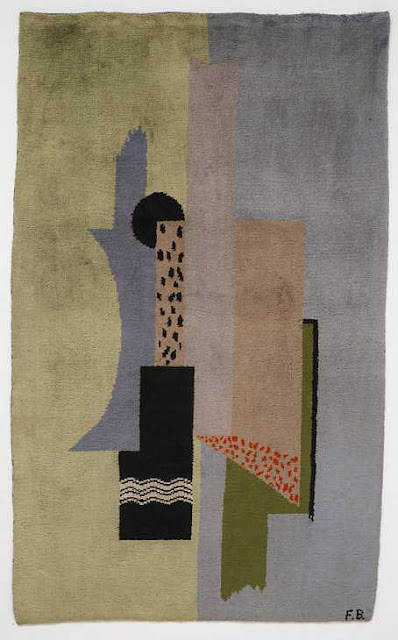
He returned to London in 1929 and for a brief period deigned modernist furniture producing works that earned him a reputation as innovative and highly talented but that he now dismisses as “absolutely horrid” and “ghastly stuff.” A Cubist inspired pattern for a rug suggests Bacon’s interest in Picasso was not entirely casual. Unfortunately, Bacon came to consider the paintings from these years “so awful” that he painted over most of the canvases and bought back others in order to destroy them; virtually none exist.
Bacon participated in group show in 1933, the same year that the critic and historian Herbert Read reproduced the artist’s ghostly “Crucifixion” in his book “Art Now.” The next year, Bacon organized a solo show, and in 1937 his work was included in an exhibition at Agnew’s in London.
But that was the last time Bacon put his paintings on public view until 1945. More than lackadaisical about his career, he was totally indifferent. Bacon had never had any formal art training, and when he began to teach himself to paint during the 30’s it seems to have been little more than a distraction from drinking, gambling and wandering around the edges of London society. “Bacon before 1939,” writes John Russell in his monograph on the artist was “Marginal Man personified.” When the Second World War began, he tried to enlist but was turned down because of his asthma. He took a variety of odd jobs, working, for a time as a house servant and a secretary. It was not until 1944, when he began to work on “Three Studies for Figures at the Base of a Crucifixion,” that Bacon says that his career as a painter began in earnest. Yet the years spent in Dublin, Berlin and Paris, and in London during some of its grimmest days, clearly left their mark. The emotional turbulence of Bacon’s life, the restlessness, the sexual indiscretions, the sense of frustration and claustrophobia he felt as a boy, the offhand disregard for social mores and, importantly, the complete lack of concern for what others might think all these became distinguishingly features of his art. Only towards the end of the war, when he was already 35 years old and just beginning to take himself seriously, did Bacon finally realize that painting was the best way for him to bring order to the chaos of his life, to translate what he calls his “obsessions” into concrete images.
Upon arriving at the Victoria and Albert, Bacon immediately marches down one of the museum’s cavernous halls looking for an elevator to the floor where Constable’s paintings are displayed. He quickly becomes lost, asks directions from a guard, takes another wrong turn and again loses his way. The circuitous routed leads him past some pottery, a display of raincoats, medieval wood carvings and jewelry, and in every case the artist becomes momentarily absorbed by what he sees. Just as he feels socially at ease with both petty thieves and wealthy patrons, he can become deeply intrigued by a Turner hanging at the National Gallery and also by a chair he glimpses in the window of Conran’s on his way to lunch. Not surprisingly, Bacon’s paintings are full of references to Ingres and the daily press, to Picasso-who, with Duchamp, remains just about the only 20th century artist he admires-and the latest fashion show.
Finally, Bacon stumbles upon the elevator and finds the Constables. “These are pictures I could live with” he says enthusiastically, bounding toward the great sketches for “The Hay Wain” and “The Leaping Horse.” Although Bacon spent a good portion of his youth in the Irish countryside, he has painted very few landscapes. Yet he feels a particular affinity with these scenes and with many of the small sketches displayed in cases nearby because, he explains, they exemplify Constable’s “free style, his tremendous spontaneity.”
“I know that in my own work,” he continues, “the best things are the things that just happened images that were suddenly caught and that I hadn’t anticipated. We don’t know what the unconscious is, but every so often something wells up in us. It sounds pompous nowadays to talk about the unconscious, so maybe it’s better to say ‘chance.’ I believe in a deeply ordered chaos and in the rules of chance.”
Bacon never makes preliminary drawings but works directly on unprimed canvas, where a, wayward brush stroke cannot easily be disguised. Sometimes he will toss a bucket of paint across the canvas in order to promote spontaneity. “I have to hope that my instincts will do the right thing,” Bacon says, “because I can’t erase what I have done. And if I drew something first, then my paintings would be illustrations of drawings.” Arriving at another of his favorite phrases, he adds, “I want to create images that are a shorthand of sensation.”
Photographs have always been a source of inspiration for Bacon. Many of his ideas, and quirky compositional devices have originated in the newspaper and magazine snapshots that he collects, and especially in the famous sequential photographs of prancing animals and walking, running and wrestling men that Eadweard Muybridge took during the last quarter of the 19th century.
In the twisted, awkward, even bizarre movements of Muybridge’s figures, Bacon sees a potential repertory of images that are at once startling and commonplace, and it is this impression of something sudden and unposed, yet absolutely true to life, that the painter wants to convey in his own work. In painting portraits, he dispenses with a sitter and relies solely on photographs and memory. Bacon uses only intimate friends as subjects, and he fears they might be offended to see him maneuvering and rearranging their faces despite the unmistakable likeness that emerges.
Bacon has also based works on paintings by Van Gogh, films by Luis Buñuel and poems by T.S. Eliot During the 50’s, he combined references to Velázquez’s “Portrait of Pope Innocent X” and a still photograph of a screaming nurse from Sergei Eisenstein’s film “The Battleship Potemkin” to create his series of screaming popes, which have achieved a degree of fame he now finds tedious. “Those references were just mental starting points, armatures on which to hang the pictures,” Bacon says. “Actually, I hate those popes. I think the Velázquez is such a superb image that it was silly of me to use it.”
Bacon insists his paintings are not about anything in particular, that nothing should be read into his borrowings from certain images, and that even his triptychs, which might seem to, be recounting a tale in three scenes, are in no ‘way narrative. He compares them to police mug shots of a suspect’s face and profiles.. Nonetheless, his paintings often contain arrows, circles, mirrors and boxes that seem to single out one or two elements as having special significance. Bacon disagrees. “I’ve no story to tell,” he says.
It is early afternoon, and so far Bacon has had nothing to drink. Once, when asked to sum up his life, he said it consisted of “going from bar to bar and drinking and that kind of thing.” The walk is short from the museum to Bibendum, the elegant restaurant in a former Michelin tire factory where Bacon has made a lunch reservation and where he is greeted warmly as a regular. He orders oysters and the first of what will be many glasses of champagne. By the end of the meal he has also drunk the better part of two bottles of wine. When the idea of a trip to the Colony Room comes up, Bacon agrees, saying that he hasn’t been to the bar in months.
It is a small, oddly shaped and rather claustrophobic place not unlike many of the rooms in Bacon’s paintings and it is almost impossible to find the entrance from the street. Photographs and caricatures of the owners and regular patrons hang haphazardly on the dark green walls. The dozen or so people who are there getting drunk in the late afternoon seem very happy to see the artist, and he seems utterly at home joking and laughing with them. They are not part of the London art scene but clearly know he is a famous painter and don’t seem to care. This especially pleases Bacon. He offers drinks all around, then orders a bottle of champagne, then another. Most people couldn’t stand up at this point, but Bacon is just getting started.
Nikos Stangos, an editor at the British publishing house Thames & Hudson, who has edited books about Bacon and known the artist for many years, notes that “Francis never expresses moral indignation about anything.” And in fact, chatting easily over drinks, Bacon recalls without the least sense of outrage or distress episodes like his arrest in 1970 for drug possession. “It was obvious at the trial that the police had planted marijuana on me, because I’m asthmatic and can’t smoke,” he says drily. “I wasn’t really worried anyway, since I recognized some criminals on the jury.”
Still, a vein of deep compassion and sorrow runs just beneath the surface of Bacon’s images. These feelings occasionally emerge in conversation, as when the subject of George Dyer comes up. A heavy drinker, Dyer was the artist’s closest friend throughout the last half of the 60’s; he died in a hotel room in Paris in 1971 at the age of 37, just two days before a Bacon retrospective opened at the Grand Palais.
Bacon did a series of three triptychs that, despite the artist’s repeated statements about never painting narratives, are transparent meditations on Dyer’s death. Dyer, naked or almost naked, is shown slumped on the toilet, vomiting into a sink or slouching in a chair, either half asleep or in a drunken stupor. Parts of his limbs and chest are invariably missing, as if they had evaporated. In all the scenes Dyer is alone and in the sort of bare, windowless room that is a trademark of Bacon’s work but in this case specifically evokes the hotel in Paris. The flesh is both roseate and ashen voluptuous and deathly and in several of the scenes Dyer casts a pink shadow that does not conform precisely to the shape of his body but resembles a thick pool of liquid or a spectral presence, like a shadowy version of the beastly Furies Bacon later painted in a triptych based on the “Oresteia.”
Perhaps the most memorable of the scenes, the centerpiece of “Triptych August 1972,” represents Dyer as hardly more than a lumpy, oozing form, his face obliterated, his body prone across a blackened doorway. There is something of Muybridge and of Michelangelo in this twist¬ed, fleshy figure, something, as well, of the Manet who painted “The Execution of Maximilian,” which was among the works Bacon chose to include in his “Art¬ist’s Eye” exhibition at the National Gallery.
To see figures that look at once corporeal and ghostly; sensual and morbid, beautiful and horrific, is to understand why Bacon has come to be regarded as one of the most distinctive and difficult figure painters of the century. The triptychs of Dyer’s last hours demonstrate what the artist means when he describes himself as a realist, as a painter devoted not to Expressionism or Surrealism but to what he has called “the brutality of fact.” During lunch at Bentley’s, Bacon had described old age as “a desert because all of one’s friends die,” and the paintings of Dyer exude this despair. The only faith they can be said to express is in the power of paint.
“I am an optimist, but about nothing,” Bacon says, repeating another of his favorite phrases. “It’s just my nature to be optimistic.” He stops to polish off the last drops from a glass of champagne. “We live, we die and that’s it don’t you think?’
Michael Kimmelman, "The Master of the Macabre: Francis Bacon," The New York Times, 26 October 1989, The Arts. Since he exhibited “Three Studies for Figures at the Base of the Crucifixion” at the Lefevre Gallery in London 44 years ago, Francis Bacon has remained master of the macabre. The writhing half-human, half animal forms he painted in that triptych may have owed something to the German Expressionists and something to Picasso. But Mr. Bacon’s nightmare was fundamentally his own.
Coming as it did at the end of World War Il, in a city that had been devastated. by bombings and spiritually enervated, the display of “Three Studies” at Lefevre seemed to many of those who saw it to epitomize the spirit of the time. Mr. Bacon had left his home in Ireland at the age of 17 and spent the next 19 years drifting throughout Europe and England. All at once, this show established him as the pre eminent painter of psychological and physical brutality. During the last four and a hair decades, Mr. Bacon has done nothing to shake that reputation.
Now he is the subject of a very handsome retrospective at the Hirshhorn Museum for his 80th birthday. The show remains here through Jan. 7, after which it is to go to the Los Angeles County Museum of Art (Feb. 11 to April 29) and to the Museum of Modern Art in New York (May 31 to Aug. 28). With nearly 60 works from public and private collections around the world, this is the first major overview of the painter’s achievements held in the United States since 1963. The exhibition has been organized by James T, Demetrion, the Hirshhorn’s director, who obtained many of Mr. Bacons best known paintings.
There is, for example, one of the startlingly colored works the artist based on van Gogh’s “Painter on the Road to Tarascon.” There are a handful of the Popes that the artist created by combining elements of Velázquez’s portrait of Innocent X with the image of a screaming nurse from “The Battleship Potemkin,” the Sergei Eisenstein film. The artist’s arresting “Man With Dog” of 1953 can be seen here, and so can at least one canvas, depicting a paralytic child walking on all fours, that Mr. Bacon derived from Eadweard Muybridge, the 19th century photographer whose studies of figures in motion have had a profound impact on the painter.
There area dozen or so small and strangely beautiful portrait heads of friends and associates as well as a handful of large triptychs from the 1960’s and 70’s, including a work from May to June 1973 that is Mr. Bacon’s wrenching meditation on the death of a friend, George Dyer.
There is not, unfortunately, the ‘Three Studies of Figures at the Base of the Crucifixion” from the 40’s, which was deemed too fragile to travel from the Tate Gallery in London. But a second version of this work that Mr. Bacon completed last year is on view, and to see it is to realize both how much the artist has changed over the years and how much he has stayed the same.
Mr. Bacon has stayed the same in (he sense that his subjects have not really varied, nor have the essential elements of his imagery. His focus remains on the human body. He continues to twist it, mangle its features, X ray it and make it evaporate, transmogrify and bleed. His figures huddle and struggle in windowless rooms, lighted only by a bare bulb that dangles from the ceiling. They vomit into a sink, find themselves pinned to the bed with a hypodermic needle or face to face with one of the ancient Greeks’ Furies.
When two men are engaged in sex, as they sometimes are in his paintings, they seem to be wrestling each other to the death. When the artist paints himself in a state of repose, it appears as if he is recovering from a crippling hangover. Even when Mr. Bacon is creating imaginary creatures, as in the second version of “Three Figures,” the references to sex and violence cannot be missed. Mr. Bacon’s images are rarely subtle.
But over the years they have been more beautifully rendered. The encrusted paint and vibrating atmosphere of such early works as “Head 1” of 1948 and “Study for Portrait (Man In a Blue Box)” from 1949 have given way to a more serene’ and fluent style. Mr. Bacon Is one of the greatest painters of voluptuous flesh. Few artists can make the body seem so palpable or transform a man turning a bathroom faucet into a figure of Michelangelesque proportions.
The artist has always imagined himself as engaged in a dialogue with past masters, not only Michelangelo and Velázquez and van Gogh but also Manet and Picasso and Ingres. At the same time, his paintings make conspicuous references to the latest furniture and clothing designs and they borrow freely from photographs in newspapers and magazines. His figures even occasionally bring to mind Willem de Kooning’s paintings of women. But Mr. Bacon says he admires almost nothing contemporary in art. Abstract painting is to him a version of wallpaper. He insists he is a realist, that he re creates the violence of everyday life.
There are times, of course, when Mr. Bacon seems more like a Surreal And there are times, it must be said, when he seems to have fallen back on tricks and melodramatic gestures. The images of cricket pads, the arrows, the swinging light cords and the slabs of beef are shallow devices ‘to which the artist succumbs. The fact is that Mr. Bacon is often most affecting when his work is least theatrical.
It is clear, for example, from paintings like “Study of Figure in a Land that Mr. Bacon can depict the outdoors vividly on those rare occasions when he puts himself to the task. His portraits, which at first look merely contorted, capture perfectly a likeness. They can also be witty. Several of the self-portraits are among the more endearing paintings in the exhibition because Mr. Bacon presents himself as charmingly ill at ease.
There are also striking images like the darkened figure entering an ‘empty house from the triptych “In Memory of George Dyer” (1971) that speak in an unusually hushed tone. And there are a few works that seem to be the beneficiaries of chance. Mr. Bacon is a believer In spontaneity, and several of his paintings have been given a jolt of energy by a sudden splash of paint or a slip of the brush.
One of the most memorable canvases in the exhibition is also one of the artist’s most recent works, his “Study for Portrait of John Edwards” from 1988, Here Mr. Bacon somehow manages to create a figure that looks at once fleshy and spectral, ashen and roseate. There is, in some ways, more of Velázquez in this austere portrait than there is in the early Popes. The work is neither histrionic nor shocking. It is mysterious and introspective and it underscores that, at the age of 80, Mr. Bacon has not missed a step.