14.6.11

Love is the Devil

Study for a Portrait of Francis Bacon

Derek Jacobi as Bacon

Love Is the Devil: Study for a Portrait of Francis Bacon is a 1998 film made for television by the British Broadcasting Corporation (BBC). It was written and directed by John Maybury and stars Derek Jacobi and Daniel Craig.

A biography of Anglo-Irish painter Francis Bacon (Jacobi), it concentrates on his strained relationship with George Dyer (Craig), a small time thief. The film draws heavily on the biography of Bacon, The Gilded Gutter Life of Francis Bacon by Daniel Farson.

The year is 1971 and controversial British artist Francis Bacon is welcomed as the "greatest living painter" by officials and the press at the Grand Palais in Paris. As the ceremony takes place, George Dyer (Daniel Craig), Bacon’s model and lover of seven years, takes a cocktail of pills and alcohol in their hotel room. Slumping into blackness, Dyer recalls the fateful day in 1964 when he attempts to burgle Bacon’s house, but meets Bacon instead. From then on his life takes on an entirely different course. A powerful and dangerous relationship develops between the flamboyant artist and the man who becomes his lover and the model for some of his most intense and celebrated paintings. SBS

Daniel Craig as Dyer

The powerfully complex relationship between the flamboyant artist and the man who became his lover and muse (for some of his most intense and celebrated paintings), explores the territory where art, love and sex dangerously collide. Cannes Festival 1998

Maybury’s biopic tells the story of the troubled relationship between painter Francis Bacon and his East End lover George Dyer. An impressive and disturbing look at the internal life of an artist. Indie

This British biographical drama probes the life of painter Francis Bacon (1909-1992), critically acclaimed as the outstanding British painter of the latter half of the 20th Century. This unsympathetic portrait of Bacon begins when George Dyer, a small-time criminal from working-class East End environs, drops through a skylight to rob Bacon's studio--and is ordered into bed by Bacon. The two become a familiar couple at Bacon's hangout, the Colony Room in Soho. Bacon's sexual interests lean toward S&M, but as the cruel Bacon loses interest in Dyer and begins to look elsewhere, the couple splits. Left to his own devices, Dyer turns to drugs and alcohol--and a tragic suicide. Visual grotesqueries and a trancelike Ryuichi Sakamoto music score capture the essence of Bacon's work (although paintings by Bacon are not seen onscreen here). The film is told in the form of a flashback from Bacon's successful 1971 retrospective at the Grand Palais in Paris to a period in the mid-'60s. Bacon biographer Daniel Farson (The Gilded Gutter Life of Francis Bacon) served as consultant on the film. Bhob Stewart

A short but suitably warped account of the love affair between the painter Francis Bacon (Derek Jacobi) and a small-time criminal named George Dyer, who was to model for some of Bacon's most convulsive works. The action, for what it's worth, starts in 1963 and ends in 1971, but the director, John Maybury, is only fitfully tempted by the demands of plot. He prefers to function in impressionistic bursts; we get a series of flickering, semi-linked scenes in which Bacon gambles, brushes his teeth with bleach, drinks with his appalling cronies, braces himself for masochistic sex, and even occasionally begins to paint-although, since the film was forbidden to show any authentic Bacons, he never gets very far. What rescues the enterprise from indulgence is, first, the audacity of Jacobi's performance, with its blend of caution and abandonment, and then Maybury's honorable attempt not so much to mimic the blurting violence of Bacon's imagery as to suggest the ways in which it was triggered by ordinary life. Anthony Lane, The New Yorker

Photographs and clippings recalling those Bacon once kept in his South Kensington atelier.
Creative Commons License
"Francis_Bacon_Inspiration_Sources_Muybury_Reconstruction" by Mariano Akerman is licensed under a Creative Commons Attribution-NonCommercial-NoDerivs 3.0 Unported License.

A thief breaks through a skylight and lands in the middle of an artist's studio. His flashlight shows paints and brushes and canvas, and scattered thick on the floor pictures and newspaper photographs of carnage, accidents, executions. Peering at him from a slightly open door is the artist. "Not much of a burglar, are you?" the artist says. "Take your clothes off. Come to bed. Then you can have whatever you want."
The artist is Francis Bacon, one of the great painters of the Twentieth Century. The burglar is a working class, not-too-bright man 30 years younger than Bacon named George Dyer. Love Is the Devil tells of Bacon's relationship with Dyer from 1964 until Dyer commits suicide in 1971.
People probably react to this movie much the same way they react to Bacon's paintings and his life. Fascinated or repelled. Or both. Bacon's view of life is certainly there for all to see. He was an aggressive masochist where pleasure is pain and degradation is arousal. On the way to a boxing match with George, he says that "boxing is such an aperitif for sex. Like bull fighting, it unlocks the bowels of feeling." Bacon's circle of friends are brittle, obnoxious, clever queens, whether or not they are gay. They may accept George as Francis' plaything but not as a serious lover. Bacon is aroused and energized by the perversity of life. "We all have nightmares," he says to George unsympathetically one night. "They can't be as horrific as real life." His paintings are usually grotesque manipulations of the human body, where the body can look like an opened side of beef and a face can look like its been turned inside out. One critic called him the morbid poet of the world of evil. That seems to me to be superficial and ignorant. A person may not like Bacon's work, but his stuff is powerful and fascinating. C.O. DeRiemer

John Maybury provides viewers with a creative portrayal of the English painter Francis Bacon. Bacon was fascinated with violence both in his paintings and in his personal life. This is evident from the very first scene in which Bacon confronts George Dyer, the inept burglar who has fallen into his studio. Jacobi's chilling, yet mesmerizing, portrayal of Bacon is seen as Maybury closes in on Jacobi's face as he deliciously anticipates being bedded and dominated by this strange young man. And while the film's frank portrayal of lust and sexual dominance is clearly evident it also explores the life of a man who consciously chose the dark side of life. The performances of both Jacobi and Daniel Craig, as Dyer, are outstanding as is the inventive camera work of Maybury, who mimics the surreal images of Bacon's paintings. Jacobi's performance and voice-over narration help to illuminate this disturbing and fascinating man. Disturbing because he revelled in the violence and pain that most of us abhor and fascinating because Bacon was so unabashedly honest in his approach to life and his work. Brenda Griffey

One character in this film describes Francis Bacon's art as "portraitures of pain," also an apt description of this movie [...]. John Maybury, the director, obviously wants the viewer to be reminded of Bacon's paintings since there are many distorted and fragmented shots. Additionally, many of the artist's friends from the bar have very unsymetrical faces. Bacon makes himself up in front of three mirrors. There are several shots where the characters are so close to the camera so as to give a fish-eye effect. There is also a scene where victims of an auto accident are lying in positions similar to those of figures from Bacon's art. For the most part these "portraits of pain" work. H.F. Corbin

In the 1960s, British painter Francis Bacon (1909-1992) surprises a burglar and invites him to share his bed. The burglar, a working class man named George Dyer, 30 years Bacon's junior, accepts. Bacon finds Dyer's amorality and innocence attractive, introducing him to his Soho pals. In their sex life, Dyer dominates, Bacon is the masochist. Dyer's bouts with depression, his drinking and pill popping, and his satanic nightmares strain the relationship, as does his pain with Bacon's casual infidelities. Bacon paints, talks with wit, and, as Dyer spins out of control, begins to find him tiresome. J. Hailey

Maybury's Study for a Portrait of Francis Bacon

Francis Bacon is undoubtedly one of the twentieth century's most celebrated artists. His bleak, disturbing paintings display an intimate relationship with the darker side of life – a constant probing of the horrors of existence that most men and women shy away from. Bacon's brilliance lies in his ability to unflinchingly depict the most grotesque aspects of the human experience. In attempting to bring a segment of Bacon's life to the screen, writer/director John Maybury has adopted a cold, distant tone that effectively captures the painter's world-view while keeping the audience at arm's length. (Curiously, none of Bacon's paintings appear during Love Is the Devil since the artist's estate refused permission for them to be used.) However, despite brilliant performances by both lead actors, Love Is the Devil is paradoxically both intriguing and uninvolving. It's what I like to call an interesting failure.
Love Is the Devil transpires in London during the late-1960s and early-1970s. It tells of the unlikely seven-year affair between Bacon (Derek Jacobi) and a lower-class burglar named George Dyer (Daniel Craig), and, in its best moments, echoes Stephen Frears' brilliant Prick Up Your Ears. The overall story – about how the homosexual relationship with Bacon destroys Dyer – is relatively static, but there are several interesting subtexts, such as the connection between art, obsession, and cruelty, and the ability of love to manifest itself in such a damaging form. Unfortunately, there's not a great deal of new material in Love Is the Devil. We've seen this kind of story – about the sordid life of a great artist – many times in the past, so much of this movie seems to be covering familiar ground.
The first image presented to us is of Bacon smelling the pillow where a lover slept. It is perhaps the most evocative moment of the film. Soon, the artist is surprising Dyer in the act of breaking into his studio. Instead of summoning the police, Bacon orders Dyer to undress and join him in bed, promising that he can take anything he wants later. Once in Bacon's life, Dyer never leaves. For a while, the painter treats his new lover with respect and affection, but, eventually, he begins to tire of him, and the less Bacon needs him, the more desperate Dyer becomes, resorting to suicide attempts. The end is perhaps inevitable.
One of the film's greatest detriments could easily have been one of its greatest assets, if director John Maybury had exercised a little restraint. His visual style is distinctive, but he doesn't know the meaning of the word subtlety, and a provocative approach turns into overkill. Maybury is fond of using odd camera angles, quick cuts, and distorted views of the characters to emphasize how skewed Bacon's world is. Good idea; bad execution. In the end, it seems like Maybury is more interested in advertising his uniqueness and versatility as a director than in making a stirring movie. He's showing off, and it hurts the film.
The thing that almost saves Love Is the Devil is Derek Jacobi's performance. Jacobi, the only actor capable of challenging Ian McKellan as the best Shakespearean thespian of this generation, is so good as Bacon that it's frightening. Jacobi is mesmerizing, and, when he's on screen, it's difficult to turn away. Daniel Craig is frequently lost in Jacobi's shadow, but never fully eclipsed. Craig does a credible job portraying Dyer as he traverses the uncertain emotional territory from a tough burglar to a weak-willed, clinging parasite. Tilda Swinton has a supporting role as the proprietress of a drinking club that Bacon frequents.
Love Is the Devil is constructed almost like an impressionist painting: it's comprised of numerous vignettes that, when pieced together and viewed from a distance, represent a larger image. However, what works well on a canvas doesn't necessarily translate to the screen, and this method occasionally makes the movie seem disjointed. Combined with Maybury's stylistic flourishes, it's enough to prevent the viewer from ever connecting with either Dyer or Bacon. We watch them from a detached perspective, observing their actions with curiosity, but never identifying with them or being drawn into their world. Although, considering Bacon's nihilistic perspective of life ("I'm optimistic about nothing," he says more than once, and he means it), perhaps that, like the movie as a whole, isn't all bad. James Berardinelli

Three Studies for a Portrait of Francis Bacon

This film will insinuate itself into the images under your closed eyelids. Meat, blood, cuts, scars, wounds, assassinations, executions, dismemberments, car accidents, beatings, and burnings will all rush together in an explosion of pain, longing, and unsatisfied hungers. Homosexual sado-masochism, not gay love. The absolute evil of pure genius. A paint brush slashes the spirit as a razor, the body. The tormented torments; the masochist punishes the sadist. Flesh is set aflame with a cigarette, not a kiss. Francis Bacon is the one true artist of the postwar era. He understood that humanity had irrevocably crossed the barrier between reason and madness. This film casts us into the abyss of the collective unconscious where we may swim or be burned to a crisp. Hold your eyelids open with sharp orange toothpicks and suck on the bloody images. Watch the film five times and then seek out Bacon's work, at least in books, if not in museums.

Visual imagery. Only missing are Bacon's pics of wild animals, vaudeville actors and reproductions of Velázquez's paintings and Muybridge's photos.
Creative Commons License "Francis_Bacon_Inspiration_Sources_Muybury_Reconstruction" by Mariano Akerman is licensed under a Creative Commons Attribution-NonCommercial-NoDerivs 3.0 Unported License.

9.6.11

Pope with Owls, 1958


Francis Bacon, Pope with Owls, 1958. Oil on canvas, 198 x 142 cm. Musées royaux des Beaux-Arts de Belgique, Brussels

La série d'études de têtes de 1949, caractérisées par les bouches criantes laissant apparaître les dentiers articulés, est annonciatrice de la série, la plus connue des années cinquante, inspirée par le portrait du Pape Innocent X, peint par Vélasquez. Dans la version bruxelloise, réalisée à Tanger en 1958, le Pape est assis sur un trône dont le dossier supporte, aux extrémités, deux hiboux. En dépit de tout protocole, le souverain pontife, apparemment inquiet, regarde attentivement vers sa droite, dans la même direction que les hiboux ; il est plongé dans le noir absolu et comme isolé dans une cage de verre à la perspective curieusement déformée. Certaines interprétations veulent y voir une ressemblance avec Pie XII, dont le silence face à l'Holocauste fut une source de controverse après la guerre. Il faut sans doute y voir d'abord le plaisir de l'artiste à subvertir une représentation vénérée par un traitement violemment expressionniste.
La force des portraits papaux réside dans les contorsions expressives du visage, dénué de toute sérénité et de toute splendeur baroque. L'arrière-plan est réduit à une surface monochrome noire permettant de mettre en valeur un espace géométrique schématisé. L'artiste déforme le visage et les vêtements papaux par de sauvages et gestuels coups de pinceau. Ce sont surtout le visage et les mains qui sont transformés en une sorte de masse de chairs torturées. La monture des lunettes est tordue et cache un regard énigmatique et distant. Bacon va plus loin que Edward Munch, qui exprime avec "Le cri" l'agonie névrotique humaine. Avec cette traduction picturale de l'image humaine oppressante, Francis Bacon est le principal interprète de l'angoisse existentielle de l'après-guerre (Jacques Lust, Musée d'Art Moderne: Oeuvres choisies, Brussels: MRBAB, 2001, p. 208-209).

3.6.11

Realism in extremis


Francis Bacon, Three Studies for a Crucifixion, 1962, oil on board, each panel 198.2 x 144.8 cm, Solomon R. Guggenheim Museum, New York

Bacon, letter to Michel Leiris, November 20th, 1981: "For me, realism is an attempt to capture the appearance with the cluster of sensations that the appearance arouses in me."


The painter, photographed by Daniel Farson, London, c. 1965


Francis Bacon, Two Figures, 1961. Oil and sand on canvas, 198.5 x 142 cm. Edward R. Broida Collection, Los Angeles

New Figuration. A very broad term for a general revival of figurative painting in the 1960s following a period when abstraction (particularly Abstract Expressionism) had been the dominant mode of avant-garde art in Europe and the USA. The term is said to have been first used by the French critic Michel Ragon, who in 1961 called the trend "Nouvelle Figuration" (Ian Chilvers, The Oxford Dictionary of Art, 2004).


Bacon, Paralytic Child on All Fours (after Muybridge), 1961. Gemeentemuseum Den Haag, The Hague

Nouvelle Figuration. La Nouvelle Figuration est un mouvement artistique qui fait la transition entre l’abstraction et une figuration dite narrative. Dès 1958, la mise en place d’un régime présidentiel invite un certain nombre de peintres abstraits à traduire leur ressenti face à une actualité menaçante. Ils s’affranchissent de la neutralité du signe par le passage du signifiant au signifié.
Un esprit frondeur traite avec insolence les sujets les plus graves : les dangers du nucléaire, les effets de la psychanalyse sur l’aliénation, l’envoi d’un homme dans l’espace, l’accouchement sans douleur, l’attentat entre factions rivales, la circulation automobile arrivée à saturation, etc. (WKP).


Bacon, Man With Glasses IV, 1963

18.5.11

Careful Planning


Matilda Battersby, Beneath the Layers of Bacon, Independent, 24 March 2010

A new exhibition seeks to shed new light on Francis Bacon's working practises and expose the fallacy of the artist's own myth.

“I can dream all day long and ideas for paintings just fall into my mind like slides,” Francis Bacon once said. The self-promulgated idea that the Irish-born figurative artist’s wonderfully twisted and subversive imagery appeared fully formed in his mind, not demanding high levels of planning, drawing and experimentation, provides an interesting mythical basis for Bacon’s genius.

But a new exhibition of torn papers and photographs, manipulated film and other archival material harvested from Bacon’s studio, seeks to some way dispel this myth, by revealing the practise-runs, thought processes and scrawlings behind some of Bacon’s best work.

Co-curators Martin Harrison and Antonia Harrison have placed the scavenged studio artefacts alongside well known Bacon oil paintings, including five works never shown before in the UK, to demonstrate the root of some of his ideas, exhibited at the Compton Verney gallery in Warwickshire from this Saturday.

“No one ever saw Bacon work. But our research reveals a very different man from the public persona, which demands we unlearn what we think we know about him,” Martin Harrison said.

The notion that Bacon was only a spontaneous creative whose work emerged effortlessly and straight into paint, is rendered “unsafe” by the exhibition, the researchers claim. Bacon’s “collusion” in such ideas has been well documented, as is his devotion to other artists who often bypassed the drawing process, such as Picasso and Chaim Soutine.

Bacon said of himself that he “never knew what to paint,” yet pages of lists from a notebook taken from his studio in Reece Mews, South Kensington stand testament to his careful planning. As do the influences of other artists, particularly Velazquez, and even filmmakers like Buñuel and Resnais, according to the Harrisons.

“There’s a real risk that the myth of Bacon – albeit one in which the artist colluded- is all we will hand on to future generations. Yet the paintings are still by far the most important thing – it is only by reaching into those that we will ask the right questions and do justice to Bacon’s real genius,” Martin Harrison said.

Francis Bacon: In Camera is at Compton Verney gallery from 27 March until 20 June 2010.

21.2.11

The Grotesque in Bacon's Paintings

Francis Bacon, British painter, self-taught artist, 1909-1992

Mariano Akerman
The Grotesque in Francis Bacon's Instinctive Paintings
1999

Artistic Grotesqueness

A critic in a British newspaper, 1985: One day he amused me by saying, in an apologetic tone: "You know, I think I've got the scream, but I am having terrible trouble with the smile." The truth was that he could get no kicks from an image of a smiling face.

"Perhaps one day I will manage to capture an instant in all its violence and all its beauty" (Bacon).[1]

1. Francis Bacon, Portrait of Michel Leiris, 1976
Oil on canvas, 35.5 x 30.5 cm.
Centre Georges Pompidou, Paris

Francis Bacon's paintings are mysterious and suggestive. They are ambiguous and constitute symbols of multi-leveled significance, which is conveyed through the artist's manipulation of the grotesque.

2. Bacon, Lying Figure in a Mirror, 1971
Oil on canvas, 198 x 147.5 cm.
Museo de Bellas Artes, Bilbao.[2]

As configurations of the ambiguous, Bacon's pictures engender both curiosity and perplexity. They often produce mixed feelings, such as attraction and repulsion at the same time. For a well-balanced yet disquieting interplay between fear and desire, vulnerability and cruelty, suffering and apathy is characteristic of Bacon's instinctive paintings.

3. Bacon, Three Studies for Figures at the Base of a Crucifixion, 1944
Oil on board, each panel 95 x 73.5 cm. Tate Gallery, London.[3]

Tension and intensity, the combination of incompatible elements, and suggestions of the monstrous or the inhuman abound in the artist's imagery.

4. Bacon, Portrait of George Dyer in a Mirror, 1968
Oil on canvas, 198 x 147.5 cm
Museo Thyssen-Bornemisza, Madrid.[4]

Bacon uses the grotesque as a means of self-expression enabling him to ambiguously communicate not only his fascination with power and violence, but also his haunted condition. The grotesque thus becomes a means of simultaneous purgation and transcendence.

5. Bacon, Motif from the right-hand panel of Three Studies for a Crucifixion
1962. Oil on canvas. The Solomon R. Guggenheim Museum, New York.[5]

Aside from their extravagance, Bacon's instinctive paintings are far from being ornamental accesories (eg., Italian grotteschi and other European designs in auricular style such as Dutch Kwabornament and German Knorpelwerk). In fact, the instintive paintings are inalienable personal reports encapsulating a private truth: the artist's contradictory feelings and sensations, which are neither decorative nor entirely evasive.

6. Bacon, Fragment of a Crucifixion, 1950
Oil and cotton on canvas, 139 x 108 cm.
Stedelijk van Abbenmuseum, Eindhoven.[6]

Through his instinctive paintings, Bacon willingly walks along the border of an emotional precipice, suggesting his obsession with sex and death, his apathy in matters of vulnerability and suffering, and his fascination with power and aggressiveness.

7. Bacon, Study from the Human Body, Figure turning on the Light, 1973-74
Oil on canvas, 198 x 147.5 cm.
Formerly in The Royal College of Arts, London.[7]

The suggestiveness of Bacon's art at once reveals and conceals the artist's ultimate intentions in such a blurred way that identity itself becomes problematic in his imagery. By depicting the ambiguously combined and the equivocally suggestive Bacon disorients the viewer, who cannot establish a precise meaning in his ever-changing images. Various readings are thus possible and they seem all equally valid.

8. Three Studies for Figures at the Base of a Crucifixion
right-hand panel, close-up
Tate, London.[8]

Considering that instinct implies the abolishment of morals, at the time of contemplating Bacon's paintings, we are to arrive at our own moral conclusions (certainly irrelevant to the artist and his calculated lack of concern). At this point, everything melts under our feet, because in Bacon's grotesque realm the only safe given is insecurity.

9. Bacon, Study of the Human Body, Figure in Movement, 1982
Oil on canvas, 198 x 147.5 cm.
Marlborough Fine Art, London.[9]

Bacon’s instinctive art, on the other hand, is certainly not the product of accident or chance, as the artist liked to claim from the mid-1960s onwards. They constitute carefully planned compositions which are inextricably related to the artist's life and also function as mysterious, anti-illustrational traps that suggest the monstrously cruel.

10. Bacon, face of Man in Blue VI, 1954
Oil on canvas, detail
Private collection.[10]

In this context, we realize Bacon's manipulation of the grotesque and the artist's fundamental intervention in turning it into a useful vehicle for self-expression. Bacon's instinctive images are thus profound but also problematic—a New Grand Manner of Painting merging the defiantly powerful, the disquietingly extraordinary, the suggestively monstrous, the sarcastically allusive, the theatrically manipulative, and the extremely personal.

11. Bacon, Self-Portrait, 1972
Oil on canvas, 35.5 x 30.5 cm.
Gilbert de Bottom Collection, Switzerland

As a species of confusion par excellence, the grotesque suspends belief and invites a search for meaning. Pushing us to consider alternative possibilities, the grotesque paralyses language and challenges categories. Grotesque art is thus thought-enlarging art.[11] This is true in Bacon's case, whose grotesque art conveys immediacy and suggests multilayered ideas granting us an active role as both spectators and interpreters. This is possibly the ultimate meaning of the artist's pictorial freedom, which he has achieved through a singular manipulation of the grotesque.

12. Bacon, Study for Bullfight No.2, 1969
Oil on canvas, 198 x 147.5 cm
Musée des Beaux-Arts, Lyon. [12]

The ambiguous element that inhabits Bacon's instinctive paintings has an immense capacity to open the valves of feeling. It is this expressive, ever-changing element of Bacon's suggestive art which proves to be extraordinarily rich: pictorial freedom is a provocative, grotesque element which coherently unites Bacon's truth and our freedom.

13. Bacon, Study from the Human Body after Muybridge, 1988
Oil on canvas 198.1 x 147.3 cm
Tony Shafrazi Gallery, New York.[12]

Notes
"The Grotesque in Bacon's Instinctive Paintings" is based on Mariano Akerman, The Grotesque in Francis Bacon's Paintings, M.A. thesis, July 1999 © 1999-2009, by the author.
1. Bacon, quoted by Paloma Alarcó, 2001 (Retrato de George Dyer en un espejo, Museo Thyssen-Bornemisza, Madrid; 19.2.2009).
2. Mariano Akerman, Figura en el espejo, Plenitud, 4.3.2008
3. "When this triptych was first exhibited at the end of the war in 1945, it secured Bacon’s reputation. The title relates these horrific beasts to the saints traditionally portrayed at the foot of the cross in religious painting. Bacon even suggested he had intended to paint a larger crucifixion beneath which these would appear. He later related these figures to the Eumenides – the vengeful furies of Greek myth, associating them within a broader mythological tradition. Typically, Bacon drew on a range of sources for these figures, including a photograph purporting to show the materialisation of ectoplasm and the work of Pablo Picasso" (Three Studies for Figures at the Base of a Crucifixion, Tate Gallery, London, exhibition label, May 2007). See also Wikipedia.
4. "En este doble retrato, George Dyer, el amante de Bacon durante años, está sentado en una silla giratoria frente a un espejo colocado sobre un extraño mueble con peana. La violencia y brutalidad de la imagen, con el cuerpo distorsionado y la cara retorcida por un espasmo, está agudizada por un halo de luz circular que proviene de un foco situado fuera del cuadro. En contraposición, la cara reflejada en el espejo, escindida en dos por una franja de espacio luminoso, no sufre las mismas distorsiones. Si pudiéramos unir las dos mitades, tendríamos un retrato bastante naturalista del modelo, con su perfil anguloso de nariz ganchuda y una expresión que combina deseo y muerte. Bacon, en la estela de los retratos dislocados de Picasso de los años centrales del siglo pasado, logra traducir los aspectos más sórdidos del ser humano" (Retrato de George Dyer en un espejo, Museo Thyssen-Bornemisza; 30.10.2009). "Ejemplo de la capacidad de Bacon para acercarse al interior de la mente de sus retratados, la anamorfosis en el espejo sirvió en esta obra para confrontar al modelo con su retrato y su reflejo, al tiempo que no deja su papel como recuerdo aterrador de la amenaza del tiempo y de la muerte. El espasmo retorcido del rostro de Dyer se contrapone a la cara reflejada en el espejo, escindida en dos por una franja de espacio luminoso que parece un reflejo en el cristal. Al igual que todos los personajes de Bacon, George Dyer está representado en solitario, aislado en un espacio vacío, para simbolizar la soledad del hombre en un mundo hostil y demostrando el clima existencialista de la Europa de entreguerras en el que se formó" (EducaThyssen, 31.10.2009).
5. "In 1944, one of the most devastating years of World War II, Francis Bacon painted Three Studies for Figures at the Base of a Crucifixion. With this horrific triptych depicting vaguely anthropomorphic creatures writhing in anguish, Bacon established his reputation as one of England’s foremost figurative painters and a ruthless chronicler of the human condition. During the ensuing years, certain disturbing subjects recurred in Bacon’s oeuvre: disembodied, almost faceless portraits; mangled bodies resembling animal carcasses; images of screaming figures; and idiosyncratic versions of the Crucifixion. One of the most frequently represented subjects in Western art, the Crucifixion has come to symbolize far more than the historical and religious event itself. Rendered in modern times by [many] artists [...], this theme bespeaks human suffering on a universal scale while also addressing individual pain. The Crucifixion appeared in Bacon’s work as early as 1933. Even though he was an avowedly irreligious man, Bacon viewed the Crucifixion as a “magnificent armature” from which to suspend “all types of feeling and sensation.” It provided the artist with a predetermined format on which to inscribe his own interpretive renderings, allowing him to evade narrative content—he disdained painting as illustration—and to concentrate, instead, on emotional and perceptual evocation. His persistent use of the triptych format (also traditionally associated with religious painting) furthered the narrative disjunction in the works through the physical separation of the elements that comprise them. / That Bacon saw a connection between the brutality of slaughterhouses and the Crucifixion is particularly evident in the Guggenheim’s painting. The crucified figure slithering down the cross in the right panel, a form derived from the sinuous body of Christ in Cimabue’s renowned 13th-century Crucifixion, is splayed open like the butchered carcass of an animal. Slabs of meat in the left panel corroborate this reading. Bacon believed that animals in slaughterhouses suspect their ultimate fate. Seeing a parallel current in the human experience—as symbolized by the Crucifixion in that it represents the inevitability of death—he has explained, “we are meat, we are potential carcasses.” The bulbous, bloodied man lying on the divan in the center further expresses this notion by embodying human mortality." Nancy Spector, Three Studies for a Crucifixion, Guggenheim Museum, New York (30.10.2009).
6. "Magie rond de ‘Salonfähige uitbater van het erge’ is de titel die gekozen werd bij Fragment of a Crucifixion uit 1950 van Francis Bacon. Bacon schildert vrijwel altijd gekwelde personen en uit hiermee zijn gevoelens ten aanzien van het leven. Als persoon houdt hij graag controle. In de loop van zijn carrière creëert hij als een toneelspeler een sfeer rondom zichzelf en zijn werk waarbij het als buitenstaander moeilijk te zien is waar fictie ophoudt en werkelijkheid begint. Niet zelden wordt de indruk gewekt dat Bacon als het ware zijn schilderijen leefde." (Eindhoven, Van Abbenmuseum, Mixed Messages, April-September 2008; trans.: Magic around the "socially acceptable operator of the worst" is the title that was chosen by Fragment of a Crucifixion in 1950 by Francis Bacon. Bacon paints almost always afflicted with this person and his feelings towards life. As a person he likes to keep control. In the course of his career as an actor, he creates an atmosphere around himself and his work in which the outsider is difficult to see where reality ends and fiction begins. Not infrequently the impression that Bacon, as it were his paintings survived; accessed 31.10.2009).
7. "To raise funds [...], Council agreed in June 2007 to the sale of a Francis Bacon painting Study from the Human Body, Man Turning on the Light, which was given by the artist as rent for a studio which he occupied in the College for a short period in the late 1960s. The painting was sold at Christie’s in October 2007 for just over £8m." (Christopher Frayling, Accounts, Royal College of Art, London, 2006/7; PDF, 31.10.2009).
8. "The face of the figure is distorted into a scream of horrific intensity. He painted many screams in later works, but none can match the impact of this one. It is the scream of the torture victim at the very moment that the lash cuts the flesh. The victim, of course, is Bacon himself. He was heavily into bondage and masochistic ritual in his private life, and he relived his painful eroticism in many of his images of trussed up, agonised, distorted figures. / Francis was fascinated by extreme forms of facial expression, and the mouth stretched open to full gape was his favourite. One day he amused me by saying, in an apologetic tone: "You know, I think I've got the scream, but I am having terrible trouble with the smile." The truth was that he could get no kicks from an image of a smiling face. It was not part of his complex sexual obsession. / Others may see in this screaming face a reflection of the agonies of war-torn Europe, a statement about the horrors of modern existence, or the entrapment and isolation of modern man in his urban cell. I see nothing of the sort. I see a devout masochist enjoying the thrill of encapsulating the secret joys of his most private moments. The great mystery about Bacon's work is why this lifelong fetishistic indulgence should have resulted in the creation of such truly great art. But then mystery is the very essence of art. As Picasso once said: 'I don't understand it and if I did, I wouldn't tell you.' " (Desmond Morris, On Francis Bacon's Three Studies for Figures at the Base of a Crucifixion, Tate Etc., Issue 8, Autumn 2006, MicroTate; 31.10.2009).
9. "Francis Bacon (28 October 1909 – 28 April 1992) was a British figurative painter. He was a collateral descendant of the Elizabethan philosopher Francis Bacon. His artwork is known for its bold, austere, and often grotesque or nightmarish imagery. [...] Bacon came to London in 1925 and although he received no formal art training, he was a totally original artist whose work always contained a heroic grandeur. He created a sensation in 1945 when he exhibited his Three Studies for Figures at the Base of a Crucifixion at the Lefevre Gallery in London [...] now in the Tate Britain’s collection in London. [... Bacon had a predilection for the] triptych format and placing his work behind glass in heavily gilded frames; [also for] the open mouth and the use of painterly distortion. [...] Bacon’s work was Expressionist in style, albeit that his distorted human forms are unsettling. He developed his idiosyncratic style during the 1950s when he achieved an international reputation. In 1958 Bacon signed a contract with Marlborough who represented him exclusively worldwide until his death in 1992 (Francis Bacon, Marlborough Fine Art, London; 31.10.2009).
10. "Man in Blue VI by Francis Bacon (estimate: £4,000,000 to £6,000,000) [...]. The finest of a series of seven major paintings that Bacon made in the spring of 1954, the present work dates to an intense [...] period in the artist’s career when he was in the midst of a tempestuous and violent romance with Peter Lacy, a veteran Spitfire pilot whom he described as the great love of his life. As Francis Bacon said of his relationship with Lacy, 'Being in love in that extreme way - being totally, physically obsessed by someone - is like having some dreadful disease. I wouldn't wish it on my worst enemy.' In 1954, as a result of the violent and divisive nature of their mutually destructive relationship, Bacon had moved out of the cottage that he shared with Lacy and was staying at the Imperial Hotel in nearby Henley-upon-Thames. It was during the 1950s that Bacon gained international recognition; his portraits and paintings of Popes were exhibited at museums around Europe and the United States. The seven paintings depicting Man in Blue are unusual in that Bacon appears to have painted the sitter from life, as opposed to using a photograph which was his usual method. The sitter is an unknown man who Bacon is thought to have met at the hotel in Henley. The work depicts an ordinary figure pulsating with life and apparent inner turmoil at the centre of a dark void. This form of depiction contrasts to that of the screaming agony of the heads and popes that the artist had been painting the previous year, and offers a more subtle representation of personal anxiety and torment" (Matthew Patton, "Francis Bacon's Man in Blue VI leads Christie's Auction of Post-War and Contemporary Art," Press Release, London, 14.1.2009; PDF, 31.10.2009). See also Mariano Akerman, Lo familiar vuelto inquietante, Imaginarium, 13.3.2009
11. Geoffery Galt Harpham, On the Grotesque: Strategies of Contradiction in Art and Literature, Princeton, New Jersey: Princeton University Press, 1982
12."Fasciné par la figure humaine depuis son entrée sur la scène artistique britannique avec le Triptyque de 1944, Bacon s'intéresse également au tableau "à sujet". En 1969, il peint trois études pour une corrida. Ce thème a pu lui être suggéré par son ami, l’écrivain Michel Leiris, auteur de livres sur la tauromachie ou encore par Picasso auquel il s’est si souvent référé dans son œuvre. Isolés dans un rond comme sur une piste, le torero et le taureau sont représentés affrontés dans l’arène. Le mouvement est suggéré par un jeu de courbes qui, sur le sol ou dans les airs, évoquent le tournoiement de la bête et les voltes de la muleta. Eliminant tout récit, Bacon donne une expression "strictement physique du jeu taurin" (Leiris). Si dans le tableau de Lyon, le grand aplat orange qui structure l’espace comporte encore un panneau ouvert où l’on aperçoit une foule, dans une autre version à la composition inversée, Bacon a fermé ce panneau. Traitées dans les mêmes tonalités de brun et de mauve, les deux figures sont indissociables l’une de l’autre. L’artiste a fait subir des déformations au corps du torero : en brossant et en nettoyant la toile, il a fait perdre à la tête sa forme humaine, lui donnant en retour des traits d’animalité. Le carré rouge qui domine la foule, frappé d’un cercle et surmonté d’une forme qui ressemble à un rapace, a été souvent rapproché d’un emblème nazi, issu de ces photographies d’actualité que Bacon collectionnait et qui jonchaient le sol de son atelier" (Etude pour une corrida n° 2, Musée des Beaux-Arts, Lyon; 30.10.2009).
12. New York, Tony Shafrazi Gallery, Francis Bacon: Paintings, April-May 2002. The exhibition was aimed "to bring to light the extraordinary relationship Francis Bacon had with John Edwards," with whom the painter "found a son and 'became' the loving father he had never had." Excerpt from catalog (31.10.2009). Picture price at the Frieze Art Fair 2008: $9 Million (Scott Reyburn, Frieze Week to Lure Billonaires with $9 Million Bacon NudeBloomberg.com, 7.10.2009).

Images
Photographs and reproductions used for educational purposes exclusively. They all belong to their respective owners. Photo credits: The Estate of Francis Bacon, 1. Centre Pompidou, 2. Museo de Bellas Artes de Bilbao, 3. Tate Gallery, 4. Museo Thyssen-Bornemisza, 5. Guggenheim Museum, 6. Van Abbemuseum, 7. Royal College of Art, 8. Tate Etc., 9. Marlborough Fine Art, 11. Plenitud, 12. Musée des Beaux Arts de Lyon, 13. Artnet.com

Resources
Painter Francis Bacon's Centennial Birthday
Tate Gallery

Idea, research and design: Mariano Akerman. Initial version: 30.10.2009 - Last version: 21.2.2011

© Mariano Akerman. All rights reserved. This article may not be reproduced or republished without the previous written consent of the author.

Impact of the article on Knol

Knol prize to Mariano Akerman as a most selected author

Impact of the article on Scoop.it!

Knol Publishing Guild: "The Best of Google Knol", 28.6.2011


Murry Shohat: "The Best of Google Knol."

7.2.11

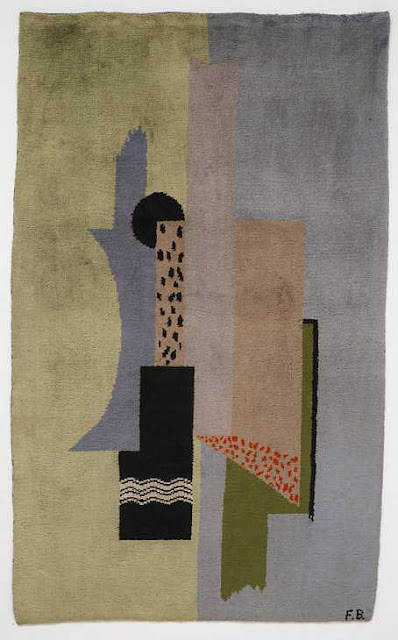
Francis Bacon: Decoration and Rugs, c.1929-30


"The 1930 Look in British Decoration"
Studio, Vol. 100, August 1930, pp. 140-41

Rare rugs and paintings which Francis Bacon completed when he was working as an interior designer are to go on display for the first time.
Hidden in private collections for decades, they escaped the artist's attempts to destroy his early artworks which he believed were inferior to his later masterpieces.
Experts claim the pieces give a vital insight into how his interior design work influenced his more famous works.
To mark the centenary of Bacon's birth on October 28, Francis Bacon: Early Work at Tate Britain will include three rugs and a painted screen dating from 1929 when the then 20-year-old Bacon was decorating homes in London.
[...] From 1928 to 1930, Bacon worked in London, Paris and Berlin, designing entire interior schemes together with individual pieces of furniture. He began to incorporate some of his interiors work into his first paintings, such as Watercolour (1929), his earliest surviving painting which appears to have evolved from his carpet designs.
Aged 19, his studio in South Kensington was featured in an interiors magazine in a piece entitled "The 1930 Look in British Decoration".
His clients included the Australian painter Roy de Maistre, who later became his mentor, and Sydney Butler, the daughter of the art collector Samuel Courthauld, for whom he designed a dining table and set of stools for her London home.
Matthew Gale, the curator of Modern Art and Head of Displays at Tate Modern, [..] said: "Seeing where an artist comes from is always an incredibly intriguing and revealing thing. Not many people know that Bacon started out in interior design because he didn't make a big thing about it in later life. [...] These works show him linked to a European modernist tradition, with a debt to Picasso and building on cubism as he made the shift from decorator to painter" (Roya Nikkhah, From Decorator to Painter: Francis Bacon's Interior Designs go on Show, Telegraph, 27.9.2009).


Rug, c. 1929. Wool, 212 x 126 x 1.5 cm. Private collection

Rug, c. 1929
Hand knotted shirt runner, 224 x 91cm.
Netherhampton Salesroom
Salisbury, Wiltshire

Ivan da Silva Bruhns
Carpet, 280 x 135 cm.
Claude Boisgirard, Paris

Rug, c. 1929. Wool, 213 x 125 x 1 cm. Private collection

Rug, c. 1929. Wool, 212 x 126 x 1.5 cm. Private collection


Late 1920s Paris was a pivotal center of artistic endeavour and decorative activity following the great Exposition des Arts Décoratifs in 1925, from which emeged the Art Deco fashion. Many artisans were commissioned to create furnishings and rugs for the grand stores, and it would have been hard not to be affected by the explosion of such new enthusiasm. Bacon saw Picasso's work in Paris. He may have also seen the work of Fernard Léger. Bacon himself recognised that during his early years as a designer he had been influenced by a number of modernists. He was reluctant in mentioning names, yet there are important stylistic correspondences with the output of artists and designers such as Ivan da Silva Bruhns, Gustave Miklos, Eileen Gray, and Fernand Léger. Perhaps even Jean Lurçat should be reconsidered.

Francis Bacon, Rug, c. 1929, compared with carpets by Gustave Miklos (Collage Rug, 1925), Eileen Grey (Runner, 1927) and Fernand Léger (Rouge, 1927). Plate by Mariano Akerman, 1.11.2008

Gustave Miklos. French artist of Hungarian origin, 1888-1967. Developed small sculptures and objets d’art in Art Deco style.
Eileen Gray. Irish lacquer artist and furniture designer, 1878-1976. Developed work in stark International Style in London from 1925 onwards.
Francis Bacon. British artist, 1909-1992. Active in decoration in London around 1928-30
Fernand Léger. French painter, 1888-1955: "Cherchant l'éclat et l'intensité, je me suis servi de la machine, comme il arrive à d'autres d'employer le corps nu ou la nature morte. On ne doit jamais être dominé par le sujet... L'objet fabriqué est là, absolu polychrome net et précis, beau en soi... Je ne me suis jamais amusé à copier une machine. J'invente des images de machines, comme d'autres font d'imagination, des paysages. L'élément mécanique n'est pas pour moi un parti pris, une attitude, mais un moyen d'arriver à donner une sensation de force et de puissance" (Musée Fernand Léger, Biot). "Allez-voir le Salon de l'automobile, de l'Aviation, la Foire de Paris qui sont les plus beaux spectacles du monde" conseillait Fernand Léger. Comme dans la vie moderne, l’objet prend une place dominante dans l’œuvre de l’artiste. Ce ne sont pas les fonctions des objets, mais leurs formes, qui l’intéresse. Il ne retient que leur valeur esthétique. D'improbables mécaniques envahissent la toile avec tous les moyens plastiques possibles, contraste, groupement, multiplication. [...] Les éléments de la composition sont à la fois empruntés à des objets manufacturés et à des éléments décoratifs" (ibid).

Bacon, Composition, c. 1929
Wool carpet, 200 x 120 cm.
Artcurial Briest-Poulain-F. Tajan, Paris

A research on Bacon's carpets ant their sources of inspiration has been developed by Clive Rogers and Jean Manuel de Noronha in Europe in 2009. Working together, they aimed to link Bacon's rugs imagery to that of other European creators. As one observes and compares the composition and motifs present in the third and fourth images illustrated in this post, undeniable affinities emerge.

Bacon, Rug, undated
Contemporary Rugs, ed. Chistopher Farr, 2002, p. 21

Bacon was creative yet not alwas able o even willing to indicate his sources of inspiration accurately. Of some of them he was of course much aware. Other sources seemingly escaped his memory or he perhaps he was not completely aware of them. Much he kept only for himself, as if it had never existed. But Bacon's work has visual referents. Rogers and Noronha are interested in Bacon's early imagery and suggest possible influences on Bacon's work (Rogers and Noronha, "Rugs of the Young Francis Bacon", Hali Magazine #162, Winter 2009).

Between 1928 and 1930, Bacon devoted a brief affair with some prevalently abstract and decorative designs. Decades later he was to become well known and recognized because of his (dis)figurative paintings. In the seventies he emphatically despised both abstraction and decoration. Nevertheless, Bacon's work never got completely rid of such aspects. No matter how much grotesque physicality he imbued his paintings with, aesthetic concerns have always been at the core of his art.

The issues of abstraction and decoration in Bacon's art were first introduced by Rothenstein and Alley (London, Tate Gallery, Francis Bacon, catalogue raisonné, 1962-64). In 1975, Bacon despised them both ("Remarks", ed. by Peter Beard, in: New York, Metropolitan Museum of Art: Bacon; and those in Interviews with Francis Bacon, ed. David Sylvester).

While researching Bacon's imagery in the Malrborough Fine Art Gallery of London in 1995, I had a conversation with Miss Valery Beston, who then reminded me of the great importance that Bacon always attributed to the way his work looked. Indeed, appearance was far from being a mere accessory in Bacon's life and work. She felt that design was a constant in Bacon's case, no mattering how chaotic anything he did might seem to be so. We were considering Bacon's working method and art production, not his private life. Besides, Miss Beston did not hesitate in stressing that none of the then recently published "Bacon biographies" had had the painter's authorization, so they all needed to be approached very cautiously.

In the lectures on Bacon that I gave in Argentina and Asia since 1992 onwards, the aspects of decoration, abstraction and design were always considered. And so was Bacon's debt to modern creators, such as De Chirico, Léger, and Picasso.

In my 1999 research, The Grotesque in Francis Bacon's Paintings, each of the above-mentioned aspects is considered, explaining that both decoration and abstraction had been qualified as "meaningless" by Bacon precisely because they did not allow him to convey his fundamental message, which was grotesque, and thus persistently yet not accidentally double-edged.

Aware of the Art Deco and modernist flavour of Bacon's rugs imagery, I have tried to compare it to that of some other modernist rug creators. My comparisons are a way of considering additional possibilities. Being that so, and as a counterpoint of Bacon's insistent claims that his work had nothing to do with decoration nor with abstraction, relating Bacon's 1929-30 work to that produced in France by the mid-1920s seems appropriate and telling. —Mariano Akerman

References and resources. For rugs in Art Deco and Modernist styles, see The Arts and Crafts Home, Brighton. On Rogers-Noronha collaboration, see The Carpet Index; and Orient Rug.

1.1.11

Focus on Francis Bacon: Newsweek 1977 and The New York Times 1989


Edward Behr, Carter S. Wiseman, and Patricia W. Mooney, "Agony and the Artist," Newsweek, 24 January 1977. For weeks the Parisian art world has been gearing up for the great day. French Minister of Culture Francoise Giroud will be there in company with other prominent government officials. So will the cream of le tout Paris and a legion of Europe’s top art critics. (One group of Italian critics and gallery owners plans to arrive in ii chartered jet.) To make sure things don’t get out of hand, the section of the narrow rue. des Beaux . Arts that runs in front of the Galerie Claude Bernard may well have to be closed to traffic an understandable precaution in view of the fact that the staff of the fashionable gallery is braced for, an onslaught of as many as 5,000 people within a matter of a few hours.
For any living painter to be the object of this kind of hub-bub is unusual. What will make this particular hubbub all the more remarkable is the fact that the occasion for it will be the opening this week of a six week showing of a selection of recent works by English artist Francis Bacon a man whose painting critics have variously described as “ nightmarish,” “grotesque” and “sadistic.”
And not without reason. One of Francis Bacon’s favorite themes is a human face – often his own caught as if at the instant of a nuclear holocaust. Another is a disembodied mouth, teeth bared in a scream. A third recurrent subject is a contorted nude figure retching into a bathroom sink in one version, nailed to a cot by a hypodermic syringe in another. Whatever the theme, the mood is one of stark isolation and the impact is always disturbing.

HIGH PRICED. Bacon’s grisly visions have outraged scores of critics and made devoted disciples of many others. And the furious controversy that has swirled around him and his paintings has helped make Bacon one of the world’s highest priced and most courted artists. One work by Bacon that sold in 1953 for a mere $85 is now valued at $171,000, and among the paintings on display in the Claude Bernard show will be a massive three panel work priced at $500,000. (A painting by jasper Johns that sold for $240,000 in 1973 holds the price record at Sotheby Parke Bernet for a living American artist.) When New York’s Metropolitan Museum of Art mounted a three month show of Bacon’s work two years ago, nearly 200,000 people flocked to see it.
Bacon’s road to such international renown and financial success has been neither short nor straight. Although his appearance is that of a man in his early 50s, he was born 67 years ago, the son of an English trainer of race horses in Dublin. (Some biographers have said that Bacon is a collateral relative of the Elizabethan philosopher Sir Francis, but the painter himself has never bothered to verify the claim.) By the age of 16, Bacon had become a wanderer: he spent most of his youth in Paris and Berlin, dabbling in the seamier sides of life and working intermittently as an interior decorator and furniture designer. Despite the fact that both the French and German capitals were humming with artistic experimentation at the time, Bacon recalls that he had little real interest in becoming an artist. “I regret not starting to paint earlier,” he says now. “It is one of the few things I do regret.”
It was not until World War II that Bacon, who by then had returned to Britain, got down to painting in earnest. Excused from his duties on a civil defense team because of asthma, he found himself with little to do and turned increasingly to art. Characteristically, he shunned any form of professional instruction and his early, work showed it. He managed to get individual pictures into group shows off and on for a number of years, but none attracted much serious attention. Only with his first, major one man show in 1949, when he was 40, did Bacon’s name begin to come up regularly in critical circles.

DEFIANT PURSUIT. What drew attention to Bacon then was his striking use of diverse, visual references to produce a style that resembled virtually nothing else that was happening in the art world at the time. While most mainstream artists in Europe and America plunged eagerly into abstraction and then pop, Bacon defiantly pursued his own brand of allusive realism. One reference that appears repeatedly in Bacon’s paintings of the 1950s is, the portrait of Pope Innocent X by the seventeenth century Spanish master Velázquez; in Bacon’s hands, Innocent frequently becomes a shrieking demon strapped to his throne
Another of Bacon’s favorite references. during this period was the bloody face of the wounded governess who appears in Sergei Eisenstein’s epic film, “Battleship Potemkin.” A third source was a series of motion studies by English-born photographer Eadweard Muybridge,, whose nudes are transformed in Bacon’s early paintings into writhing, faceless victims of unknown agonies.
At first, many. critics condemned Ba¬con’s quasi realistic style as outdated and. his choice of subject matter was branded as sensational. (His reputation in the U.S. was not helped by his description of the work of pioneering abstract expressionist Jackson Pollock as “a lot of old lace.”) But despite all resistance, Bacon’s reputation continued to grow. In 1965, he was hailed by the influential English art critic John Richardson as “the first modem painter of international caliber that the British have produced.” A 1971 retrospective of 108 Bacon paintings at the Grand Palais in Paris was an overwhelming success. And the turnout for the 1975 show at New York’s Metro¬politan Museum which seldom grants such an honor to a living artist constituted a triumph in a bastion of anti Bacon feeling.

EVEN MORE TORTURED. The show that opens in Paris this week includes 37 major works, many of which have never been shown publicly before. In addition to the $500,000 “Triptych” one of a series Bacon has done over the years in the traditional three panel form some of the most intriguing works on display are the portraits of George Dyer, a close friend of Bacon’s who died five years ago. Bacon insists that he dislikes using himself as a model, but there are also several self portraits in the show. “I have been reduced to doing a lot of them recently,” he says, “because all my friends are dead.”
In contrast to much of Bacon’s earlier work, many of the paintings at the Galerie Claude Bernard show a greater assurance in choice of color and line. The technique is no less striking, but it is subtler, even mellowed. What has not mellowed is Bacon’s choice of subject matter. His faces are less crude, but their expressions are no less agonized. The figures are more refined, but, if anything, they are even more tortured. There is no better illustration of this than the painting entitled “Three Figures and Portrait,” done in 1975. The left hand figure is bent double on his knees, his hands apparently tied behind his back as if to await execution. The neck is wrenched at an impossible angle and the vertebrae of his spine have been entirely stripped of flesh.

‘MAN IS AN ACCIDENT.’ If Bacon’s painted images leave any doubt about the persistence of his grim interpretation of human experience, his words do not. In an interview fourteen years ago with David Sylvester, a British art critic and personal friend, Bacon declared: “Man now realizes that he is an accident, that he is a completely futile being, that he has to play out the game without reason.” In a talk with Sylvester only last year, Bacon said: “I think of life as meaningless; we create certain attitudes which give it a meaning while we exist, though they in themselves are meaningless, really.”
It is Bacon’s refusal or inability to abandon this litany of despair that has provoked most of the criticism of his work in recent years. In a review of the Metropolitan show, Hilton Kramer of The New York Times asserted that, in the wide open world of contemporary art, “to traffic in images of sexual violence and personal sadism is a good deal less shocking than, say, to be avowedly Methodist.” Prof. Rainer Crone of Yale University’s Department of Art History faults Bacon for not participating in any of the new technical developments of contemporary art. Bacon, argues Crone, “is still dealing with the issues that were relevant before or during cubism.” Even more bitingly, André Fermigier, art critic of Le Monde and one of France’s most influential writers on art, has admitted: “Personally, I find Bacon’s obsessions somewhat monotonous.”
A renegade from the outset of his career, Bacon has never set much store by other people’s opinions about art, wheth¬er his own or anyone else’s. He dismisses ,that durable favorite of the critics Joan Miró as “pleasing and decorative, but definitely lightweight.” He finds the current school of hyper realism “boring.” And he has little patience with criticism of his own work. In response to attacks on his fascination with grim subject matter, Bacon recently declared: “I’ve always hoped to put over things as directly and rawly as I possibly can, and perhaps if a thing comes across directly, people feel that is horrific. People tend to be offended by facts or what used to be called the truth.” Curiously enough, while American scholars and critics have proved to be some of Bacon’s most energetic oppo¬nents, American artists have provided him with some of his strongest support. Pop master Larry Rivers, who concedes that Bacon does some “very peculiar work,” nevertheless considers the Englishman “one of the best” of living artists. Another American who has high praise for Bacon is Jim Dine, a leading figure of the New York school of pop art. “There are only a handful of painters in the world whom I respect,” says Dine, “and I consider Bacon a great, great painter.” Andy Warhol, the man who enshrined the Campbell’s soup can and is now virtually an institution in the U.S art world, admits to paying Bacon the sincerest form of flattery. “I copy his color,” says Warhol, “and his skulls.”
Despite his conspicuous success, Bacon pursues a private life little changed from that of his Wanderjahre before the war. He occasionally shares a fiat with a friend in Paris and he owns a small country house near Colchester in Essex. But he spends most of his time in the familiar clutter of his London studio. The furnishings of the living area there include two battered sofas, a broken mirror and naked lightbulbs. The workroom, also lit by a bare bulb, is piled literally knee deep in torn photographs, art books, medical texts and assorted other detritus of Bacon’s craft.

‘MEMORY TRACKS.’ Bacon once explained the semi squalor of his quarters to Henry Geldzahler, the organizer of the Metropolitan show in New York, by saying that “the places that I live in … are like an autobiography. I like the marks that have been made by myself, or by other people, to be left. They’re like memory tracks for me.” For all the grim themes of his paintings, Bacon revels in witty and amusing company. But he seldom goes out on the town and when he does, the destination is likely to be Muriel’s, a London watering hole frequented by a mixed crowd that includes a sprinkling of Fleet Street journalists. He drinks heavily (champagne bottles tend to pile up around his works in progress) and on those occasions when he indulges in luxury outings to London’s better restaurants he tips outrageously and refuses to let anyone else contribute to the bill. Although discreet about details of his social life, Bacon makes no secret of the fluet that he is homosexual and occasionally jokes about the turbulence of his emotional affairs.
Although the massive amounts of cash paid for his paintings have not tempted Bacon to put a fresh coat of paint on his studio walls or even to add much to his two suit wardrobe, they have given almost free rein to his longtime passion for gambling. In his early years in London, Bacon used to convert his Cromwell Place studio into a nighttime casino hilly equipped with a roulette wheel and a chemin de fer table. The artist himself served as croupier, and to hear him tell it, he made a bundle. “But,” he recalls, “as soon as one could travel after the war, I went off to Monte Carlo and lost the lot in two weeks.” The experience did little to cool his preoccupation with gaming and he continues to bet with enthusiasm. But his luck has apparently not changed significantly since the early days. “As an ex croupier,” he says, ‘I know how to gamble, but that’s never helped me much.”

“INTUITION AND LUCK.’ Perhaps more than anything else, Ba¬con’s devotion to gambling offers a clue to his refusal to abandon his own visions and join the mainstreams of contemporary art. In 1953, in a tribute to the British painter Matthew Smith, Bacon wrote that “painting tends towards a complete interlocking of image and paint, so that the image is the paint and vice versa. Here the brush stroke creates the form and does not merely fill it in. Consequently, every movement of the brush on the canvas alters the shape and implications of the image. That is why real painting is a mysterious and continuous struggle with chance” More recently, Bacon told David Sylvester that painting is “pure intuition and luck, and taking advantage of what happens when you splash the bits down.”
Bits of paint, chips, dice or cards. At the gaming table, ‘says Bacon, “I feel I want to wins but then I feel exactly the same thing in painting. I feel I want to win even if I always lose.” If the excitement surrounding the new show at the Galerie Claude Bernard is any indication, Bacon is riding a winning streak.


‘I Only Paint for Myself.’ On the eve of Francis Bacon’s major show at the Galerie Claude Bernard in Paris, European Regional Editor Edward Behr sat down with the artist for a wide ranging discussion of his life, his work, his critics and the contemporary art scene in general. Below, excerpts from their conversation:

BEHR: How do you account for the hostility your paintings arouse?

BACON: If I thought about what the critics said, I shouldn’t have gone on painting.

Q. But how do you feel about the critics who say you put too much emphasis on death and decay and angst? Self portrait, 1969: ‘Death is always with us’

A. To me that is so totally stupid. If one thinks of life, what is it? The inevitability of death is always with us, from birth onward. I don’t emphasize it. I accept it as part of one’s existence. One is always aware of mortality in life, even in a rose that blooms and then dies. I’ve never understood this aspect of criticism against me and I don’t, now, take any notice of it. It seems to me that the people who think in this way have never really thought about life. ‘One has only to turn to the great art of the past to Shakespeare, to the Greek tragedies to realize how much of it was concerned with mortality. I’m not interested in violence. During the Vietnam war there was more violence on American television every afternoon than there is in all of my work. I accept violence, yes, I accept it as part of one s existence.

Q. What about the so called morbid aspect of your paintings? Some say that you have even used anatomical books for inspiration.

A. There was this book, which I picked up at a secondhand bookstore in Paris a long time ago before I really began painting at all, that was about skin diseases in the early nineteenth century. It was hand colored and very beautiful. I’m allergic to turpentine and wear gloves when I’m painting. But nevertheless, I occasionally get rashes on my hands and their color is tremendously suggestive to me, not necessarily horrific.

Q. There’s also the charge leveled against you that you are a loner who has failed to influence anyone else.

A. True, I don’t know of any painter whose work interests me and in whose work I see any [of my] influence.

Q. Are there any young painters whom you find to be interesting?

A. Not at the moment, and I consider that an unfortunate thing.

Q. What does interest you as you survey the current art scene?

A. I have the feeling that something very remarkable will come out of the United States. As I’ve repeatedly said, I also feel that someone like Jackson Pollock is the most overrated artist. Americans are determined to make an American art that hasn’t been influenced by anything else. I’m not sure this won’t limit them in some way. Communication being what it is, why not accept the whole thing?
I’m not interested in the abstract artists. I understand that this type of painting was a logical course to embark on. But it seems to me the subject matter in abstract art, no matter how far you take itand how far you destroy it, instantly seems to degenerate into a form of decoration. And just now figurative art is the most difficult and problematic thing. Many people are trying to return to it, but what are they returning to? They’re returning to illustration and hyper realism and what’s the point of that? It’s of no interest at all. I must say that to me pop art is more interesting than abstract expressionism and hyper realism, which are ridiculous and boring.

Q. Is there anyone among recent con¬temporary painters you admire?

A. I admire Marcel Duchamp. He explored things within his lifetime in a remarkable way. Though he wanted art that wasn’t art, he was the, most esthetic, probably, of all artists of the twentieth century.

Q. Were you influenced by Duchamp?

A. It’s difficult to say. I have been influenced by practically everything from prehistoric artifacts onward. I have looked at everything. I am rather like a grinding machine through which everything has gone. And what comes out is what comes out. All visual things have always been of immense interest and assistance to me. How are the influences felt? One would have to know how the unconscious works.

Q. Have you ever been tempted to undergo analysis to find out how your unconscious works?

A. I don’t feel it would help me in my work and it wouldn’t help me otherwise. I’ve never had those problems in my life because I accept my problems.

Q. You’ve repeatedly described how at a certain point in your work, accident and irrationality actually take over, that you are, in effect, a medium through which the paintings actually happen. Are you also a medium in other respects, are you interested in the occult?

A. It’s perfectly true that I work hoping that chance and accident will just run for me. But I’m not interested in the occult nor do I believe in it. I’m a very rational person. I use my sensibility in painting. I don’t think I’m one of those gifted people. But I’ve looked at everything, and I think that I am profoundly critical and that out of my critical sense I’m able to use the accident that comes to me.

Q. In the past you used a number of key paintings the Cimabue crucifixion, the Velázquez portrait of Pope Innocent X as keys which unlocked some of your own visual experiences. But you have not done so in the last ten years. Why not?

A. Maybe it’s because I’ve absorbed them all and they’re beginning to make their own compost within me.

Q. When you were in Rome, I understand. you, did not. bother to see the original of Pope Innocent.X. Why not?

A. I’m a very lazy person. When I see pictures even that I like I can’t. look, at them for long because I find that it’s afterward that they begin to work on me, that they unlock valves of sensation within me. It’s what I receive from them that counts.

Q. To what do you attribute the devel¬opment of the: idea for the $.500,000 “Triptych” that is included in the Paris. show?

A.The center panel came to, me after’ I’d looked at photos of some Australian cricketers. Suddenly this, image, which was nothing like cricket, began to form itself. The head in the left panel happens to be someone I know.

Q. Everyone who writes about you notes how ‘much younger you look than you really are. Do you do anything to keep that way?

A. It’s a family thing, I think. We tend to look younger than we are. But apart from my mother, who lived to be 87, we also tend to die young. Do I consciously keep in shape? No, I don’t. I do a lot of’ standing, especially with the big canvases, and I like that. There are certain days when you feel the muscles are not going to work for. you. I like living in an overheated atmosphere because for me that’s when. brain and muscle come to¬gether. I’ve always drunk too much. I’m not a person who can sit down and relax. I’m always active in a sense. And work breeds work.

Q. Do you have any interest in your paintings when they’re finished?

A. I can’t believe my paintings are for people. I can only paint for myself. I try to give myself a kick. But I don’t know where my paintings are.
It used to be a real production line. They used to go to the Marlborough Gallery in New York and then they just went.. I didn’t want to see them again. The few I own are at the Paris showing; Living as I do, what am I going to do with them? I’m glad when they go.

Q. But don’t you care about people’s reactions to your work?

A. One’s always pleased when a few people one likes and whose opinions one respects happen to like one’s work or’ part of it. But otherwise I don’t really care, because I don’t think many people are interested in painting. Oh, yes,’ there’s a great interest in the financial side of it in painting as business, as a stock market, but very few people have any real, feelings about painting certainly not the critics.

Q. But surely you’re glad that your works is in the major museums around the world?

A. Except for a few people, it’s the only way the larger triptychs can be seen. Most people simply don’t have enough room for them.

Q. Would you like to see some kind of Bacon Foundation to house a permanent collection of Bacons after you’ve gone, as some other major painters have made provision for?

A. I don’t care. I find the profound vanity of these old men who try to im¬mortalize themselves through founda¬tions very boring. I hope there’ll be a foundation for the best of Picasso’s work, but they would have to be so carefully selected that I expect it’s out of the question.
I’m lucky, ‘since my work is not really liked and difficult to sell, to live my life by. something that obsesses me to try and do. I paint to please myself. I suppose I could have done other things. But it’s real luck to be able to earn something by doing what you obsessively feel you have to do.


Michael Kimmelman, "Unnerving Art," New York Times Magazine, 20 August 20 1989. The doorbell to Francis Bacon’s ramshackle mews house in South Kensington, London, has not worked for some time. Visitors knock loudly and then cling to a rope bannister while climbing the steep, narrow stairs that lead to the kitchen, bedroom and studio. Bacon cannot paint anything so large it won’t fit down the steps and out the door. On those infrequent occasions when the artist permits someone to see him at home, he must usher guests past the kitchen that includes a bathtub to the cramped bedroom that doubles as a living room. He has lived in this place for more than a quarter of a century. Widely regarded as perhaps the greatest living figure painter, a man whose works have lately sold for millions of dollars at auction, Bacon presumably could live anywhere in London. A few years ago he set himself up in a handsome and spacious home on the Thames, but he says the speckled light that reflected off the river and into his studio’s windows proved too distracting, so he moved back here.
Even more than most people, Bacon is full of contradictions. He will turn 80 in late October, yet his wide eyes, chubby cheeks, pouting mouth and hair failing casually over his brow give him an astonishingly boyish look. Although he moves gingerly nowadays, his step retains traces of the jaunty side to sidespring that was a characteristic of his youth.
He can be intensely private yet disarmingly frank. With almost no prompting he details his fondness for alcohol and for men, his kinship with gangsters and drunks, his antipathy toward certain politicians, fashion designers and fellow painters. If coaxed just a bit, Bacon tells wonderful stories about being in Morocco with the novelist and composer Paul Bowles or wandering through galleries with Giacometti (“He liked all the wrong pictures,” Bacon recalls with a laugh). Friends know he can be ornery and unpredictable, especially after a few drinks, but they also know him as a man of tremendous generosity, wit and vulnerability. Although he has created some of the most alarming and outrageous images ever painted, Bacon is in fact immensely likeable and kind, a true gentleman.
He is especially eager to express opinions about art and literature. A few days earlier, over a leisurely lunch of wine, oysters and deviled crab at Bentley’s in London, Bacon talked about Velàzquez and Degas, Boulez and Freud (“Does anyone go to analysis anymore?” he asked with apparent sincerity), Proust and Yeats (whose productivity in old age particularly intrigues Bacon) with the passion of the self educated. A recent exhibition of early works by Cézanne prompted waves of enthusiastic commentary, although when the conversation eventually turned to American painters, he became coy. “He does those women, nice man, what was his name?” is the extent of Bacon’s remarks about Willem de Kooning, and about Jackson Pollock he said: “I can’t see the point of those drips, and I think he couldn’t do anything else particularly well.” Subtly, Bacon manipulates a conversation so that it never strays from subjects he is prepared to discuss, and it is almost impossible to get him to talk about anything else.
He particularly dislikes analyzing his own work. “If you can talk about it, why paint it?” is one of his favorite ripostes and he tends to fall back on canned remarks as a way of sidestepping queries.
Bacon hates pretense, and he can be modest to the point of self deprecation. When London’s National Gallery asked him four years ago to do the first of the “Artist’s Eye” shows, in which prominent British painters juxtaposed their works with favorites from the museum’s collection, Bacon refused to include his own canvases.
He eschews almost all the trappings of success. Whennecessary, he reaches into his pocket for a wad of cash to cover expenses, which may include an elegant suit, gambling debts, medical costs for an ailing friend, lunch at a swank restaurant or champagne for everyone at the Colony Room, the rundown drinking club in Soho he has been going to for more than 40 years. In an art scene that has become dominated by commercial excess and ironic posturing, Bacon seems like a character from an altogether different time, a genuinely serious painter, a survivor from the generation of post war intellectuals for whom culture was not largely a matter of money.
Now he is the subject of a retrospective, on the occasion of his upcoming birthday, that open in Oct. 12 at the Hirshhorn Museum in Washington. The first Bacon exhibition in the United States since a modest show at the Metropolitan Museum of Art in 1975, it travels to the Los Angeles County Museum of Art in February 1990 and to the Museum of Modern Art in New York in May 1990.
Bacon settles himself behind a table next to the single window in his bedroom where four bare bulbs hanging on wires from the ceiling provide most of the illumination on a gray day. A cot is tucked at the far end of the room behind two old couches and a couple of dressers. There is a space heater in one corner. Years ago, Bacon owned paintings by the English artists W.R. Sickert and Frank Auerbach, but he gave those away. Several tattered photographs of his own works are now taped above the kitchen sink and around his studio. Otherwise the walls are bare. “I cant live with pictures,” he explains.
Only after a little while does the artist suggest taking alook at the studio, and even so, he clearly feels some hesitation about it, as if fearful of revealing one of his more intimate secrets. Bacon can appear very open and jovial to strangers, but he can be extremely reticent when it comes to certain aspects of his work, and this room is one of them.
The studio, on the other side of the kitchen, is shaped like the bedroom but has a skylight that Bacon installed some years ago. It is a mess. Aged paint tubes, discarded rags, brushes, papers and dust (he has incorporated the dust in certain paintings to suggest sand dunes) have at cumulated over the course of two decades and been swept into waist high piles around the floor.
Bare bulbs dangle from the ceiling. “I once bought a beautiful studio round the corner in Roland Gardens with the most perfect light, and I did it up so well, with carpets and curtains and everything, that I absolutely couldn’t work in it,” he once told an interviewer. “I was absolutely castrated in the place. That was because I had done it up so well, and I hadn’t got the chaos.”
Bacon has noted, only half in jest, that the closest he comes to abstract painting is on the walls of his studio: he uses them as a palette, and they are covered with multi-colored dabs of pigment. On one easel rests a small portrait of Bacon’s friend and, for the last several years, favorite subject, John Edwards, but all the other canvases have been turned to the wall, and the artist declines to show them. “There’s nothing on them,” he says. Bacon remains in the doorway throughout, anxious to leave.
He suggests a walk to the Victoria and Albert Museum before lunch. “If you’d like, we can see the Constables,” he offers, and a minute or two later slips a leather jacket over his turtleneck sweater and eases himself down the front steps and toward the street.
In April 1945, Bacon exhibited at the Lefevre Gallery in London a triptych entitled “Three Studies for figures at the Base of a Crucifixion” now at the Tate Gallery. Bacon’s trio of half-human, half animal creatures, mutilated and eyeless, their necks elongated and teeth I, were perched on tables or pedestals in rooms with disorienting fun house proportions. They were roughly, angrily drawn, suggesting both Picasso’s and Francis Picabia’s works from the 1920’s and something of German Expressionism. But nothing precisely like the “Three Studies” had been seen before. Bacon’s tortured and menacing figures seemed to capture perfectly the anguished claustrophobic of war ravaged England. At a time when painting in Britain, like so much else, had become enervated, these potent images were a sign of renewed vitality. Those who went to the Lefevre Gallery may not have liked Bacon’s work, but they surely wouldn’t forget it. Bacon had made his mark.
During the next decades the artist developed his now famous repertory of blurred figures, screaming popes, butchered carcasses and twisted portraits images that continue to occupy his attention today. They have inspired critics to classify him as a surrealist or an Expressionist, and skeptics to describe s a sensationalist or a lunatic.
Bacon insists he is a realist, that he does not paint merely to shock. “What is called Surrealism has gone through art at all times,” he says. “What is more surreal than Aeschylus?”
Bacon maintains he is simply aiming to reproduce as immediately and directly as possible, what his friend, the French anthropologist and poet Michel Leiris, calls “the sheer fact of existence.” This can encompass, Bacon points out, both violence and beauty, absurdity and romance. “You can’t be more horrific than life itself,” he is fond of saying. Still, his paintings have lost none of their power to unnerve.
In part for this reason, private collectors have not stood in line to buy, and although the work has always been very popular in France, Italy and Germany, it has engendered more respect than enthusiasm in the United States and even in Britain. The poet Stephen Spender, one of Bacon’s oldest friends, says, “I wanted to get a painting, but no one in my house really wanted one.” Margaret Thatcher once described the artist as “that man who paints those dreadful pictures.” And in the recent film “Batman,” the only painting in Gotham City’s Flugelheim Museum that the Joker prevents his henchmen from destroying is a Bacon.
“I think Americans have tended to measure him against de Kooning and find him less good,” says David Sylvester, an English art historian, author of a book of penetrating interviews with Bacon, and one of the painter’s most devoted friends. Spender insists that “American artists provide for Americans a foreground of activity that they can’t see beyond.”
Yet a third view is held by Lawrence Gowing, the English art historian and painter who has been an admirer of Bacon for many years. “Abstract Expressionist taste was buoyed up by a solid optimism and a feeling that painting was getting better, that a way was opening to something fruitful,” he states. “But Bacon’s painting is rather tragic, and his whole work is an overt criticism of abstract art.”
There are, however, few important museums of 20th century art that do not own, or at least covet, one of Bacon’s paintings, and his canvases are prominently displayed in London’s Tate Gallery and the Scottish National Gallery of Modern Art in Edinburgh. Bacon’s work has increasingly been so ambitious in scale and polished in execution that it looks specifically designed for public exhibition, as if the artist were demanding his place in the museum beside Manet, Picasso and the other modern masters. Gowing describes these latest canvases, even the most violent, as “classically serene”.
Consider, for example, one of his most recent works a second, much larger and arguably more affecting rendition of the “Three Figures,” in which Bacon has added an element of ambiguity to the gruff original by refining its forms. The new version is like a memory of the earlier one, still vivid but less tactile. After an initial reaction of horror or wariness, the viewer’s attention almost invariably focuses on the strange lyricism and meticulousness of the paintings. Bacon has a quirky and rather wonderful sense of color, and there have been very few artists who have ever managed to depict flesh in such a voluptuous way. The word “shocking” is still constantly used to describe Bacon’s works, but in fact they can be exceptionally beautiful and very moving.
The artist insists that his paintings be hung in gold frames and protected by a sheet of glass, which he thinks imparts evenness and sheen to his unvarnished surfaces. This style of presentation recalls the Old Master pictures that Bacon so admires; it also heightens the tension that comes from representing bizarre or subversive scenes in a highly formal, elegant way. He may depict two Michelangelesque nudes thrashing on a bed, but he shrouds the details behind seductive, titillating veils of paint. There is decorum to Bacon’s impropriety a paradox that describes the artist himself: He talks about sex and alcohol the way most people discuss the weather, but he also exudes a natural courtliness and grace, as if he were a good boy trying to be bad.
The son of a racehorse trainer (and a collateral descendant of the great Elizabethan statesman and philosopher), Bacon moved with his family between Dublin and London during the first years of his life. He was the second of five children He never got along with his parents, who, in turn, never supported the idea of his becoming a painter.
Asthma made school a problem, so he was tutored by clergymen at home, where in general he was left to his own devices. These involved what his heavy-gambling but strict father considered behavior so unacceptable-Bacon had sex with some of the grooms at the stables and was once caught trying on his mother’s underwear-that he banished the youngster. At the age of 16, Bacon set out for London, and then Berlin.
There, in a city devoted to extravagance and excess Bacon could indulge in sexual escapades and gambling sprees; he spent long nights in transvestite bars and endless hours with the sort of rough-and tumble characters who would always form a part of his social circle.
“Berlin was a very violent place emotionally violent not physically and that certainly had its effect on me,’ Bacon says. But I wasn’t the slightest bit interested in art until about 1930. 1 lived a very indolent life. I was absolutely free. I drifted for years.” He smiles. “You know, when you’re young, there are always people who want to help.”
He also spent time in Paris and although he says he was not interested in art, Bacon remembers attending an exhibition of Picasso’s surreal, biomorphic bathers painted in the 20’s. Over the years, he has given different accounts of how significant this event was to his own development but he certainly left Paris with a particular notion of artistic life properly spent. Bacon has always cultivated an image of himself as an instinctive painter, a loner, someone who is unconcerned with success qualities that make him resemble more the French artist of the 20’s than the celebrity artist of today.
He returned to London in 1929 and for a brief period deigned modernist furniture producing works that earned him a reputation as innovative and highly talented but that he now dismisses as “absolutely horrid” and “ghastly stuff.” A Cubist inspired pattern for a rug suggests Bacon’s interest in Picasso was not entirely casual. Unfortunately, Bacon came to consider the paintings from these years “so awful” that he painted over most of the canvases and bought back others in order to destroy them; virtually none exist.
Bacon participated in group show in 1933, the same year that the critic and historian Herbert Read reproduced the artist’s ghostly “Crucifixion” in his book “Art Now.” The next year, Bacon organized a solo show, and in 1937 his work was included in an exhibition at Agnew’s in London.
But that was the last time Bacon put his paintings on public view until 1945. More than lackadaisical about his career, he was totally indifferent. Bacon had never had any formal art training, and when he began to teach himself to paint during the 30’s it seems to have been little more than a distraction from drinking, gambling and wandering around the edges of London society. “Bacon before 1939,” writes John Russell in his monograph on the artist was “Marginal Man personified.” When the Second World War began, he tried to enlist but was turned down because of his asthma. He took a variety of odd jobs, working, for a time as a house servant and a secretary. It was not until 1944, when he began to work on “Three Studies for Figures at the Base of a Crucifixion,” that Bacon says that his career as a painter began in earnest. Yet the years spent in Dublin, Berlin and Paris, and in London during some of its grimmest days, clearly left their mark. The emotional turbulence of Bacon’s life, the restlessness, the sexual indiscretions, the sense of frustration and claustrophobia he felt as a boy, the offhand disregard for social mores and, importantly, the complete lack of concern for what others might think all these became distinguishingly features of his art. Only towards the end of the war, when he was already 35 years old and just beginning to take himself seriously, did Bacon finally realize that painting was the best way for him to bring order to the chaos of his life, to translate what he calls his “obsessions” into concrete images.
Upon arriving at the Victoria and Albert, Bacon immediately marches down one of the museum’s cavernous halls looking for an elevator to the floor where Constable’s paintings are displayed. He quickly becomes lost, asks directions from a guard, takes another wrong turn and again loses his way. The circuitous routed leads him past some pottery, a display of raincoats, medieval wood carvings and jewelry, and in every case the artist becomes momentarily absorbed by what he sees. Just as he feels socially at ease with both petty thieves and wealthy patrons, he can become deeply intrigued by a Turner hanging at the National Gallery and also by a chair he glimpses in the window of Conran’s on his way to lunch. Not surprisingly, Bacon’s paintings are full of references to Ingres and the daily press, to Picasso-who, with Duchamp, remains just about the only 20th century artist he admires-and the latest fashion show.
Finally, Bacon stumbles upon the elevator and finds the Constables. “These are pictures I could live with” he says enthusiastically, bounding toward the great sketches for “The Hay Wain” and “The Leaping Horse.” Although Bacon spent a good portion of his youth in the Irish countryside, he has painted very few landscapes. Yet he feels a particular affinity with these scenes and with many of the small sketches displayed in cases nearby because, he explains, they exemplify Constable’s “free style, his tremendous spontaneity.”
“I know that in my own work,” he continues, “the best things are the things that just happened images that were suddenly caught and that I hadn’t anticipated. We don’t know what the unconscious is, but every so often something wells up in us. It sounds pompous nowadays to talk about the unconscious, so maybe it’s better to say ‘chance.’ I believe in a deeply ordered chaos and in the rules of chance.”
Bacon never makes preliminary drawings but works directly on unprimed canvas, where a, wayward brush stroke cannot easily be disguised. Sometimes he will toss a bucket of paint across the canvas in order to promote spontaneity. “I have to hope that my instincts will do the right thing,” Bacon says, “because I can’t erase what I have done. And if I drew something first, then my paintings would be illustrations of drawings.” Arriving at another of his favorite phrases, he adds, “I want to create images that are a shorthand of sensation.”
Photographs have always been a source of inspiration for Bacon. Many of his ideas, and quirky compositional devices have originated in the newspaper and magazine snapshots that he collects, and especially in the famous sequential photographs of prancing animals and walking, running and wrestling men that Eadweard Muybridge took during the last quarter of the 19th century.
In the twisted, awkward, even bizarre movements of Muybridge’s figures, Bacon sees a potential repertory of images that are at once startling and commonplace, and it is this impression of something sudden and unposed, yet absolutely true to life, that the painter wants to convey in his own work. In painting portraits, he dispenses with a sitter and relies solely on photographs and memory. Bacon uses only intimate friends as subjects, and he fears they might be offended to see him maneuvering and rearranging their faces despite the unmistakable likeness that emerges.
Bacon has also based works on paintings by Van Gogh, films by Luis Buñuel and poems by T.S. Eliot During the 50’s, he combined references to Velázquez’s “Portrait of Pope Innocent X” and a still photograph of a screaming nurse from Sergei Eisenstein’s film “The Battleship Potemkin” to create his series of screaming popes, which have achieved a degree of fame he now finds tedious. “Those references were just mental starting points, armatures on which to hang the pictures,” Bacon says. “Actually, I hate those popes. I think the Velázquez is such a superb image that it was silly of me to use it.”
Bacon insists his paintings are not about anything in particular, that nothing should be read into his borrowings from certain images, and that even his triptychs, which might seem to, be recounting a tale in three scenes, are in no ‘way narrative. He compares them to police mug shots of a suspect’s face and profiles.. Nonetheless, his paintings often contain arrows, circles, mirrors and boxes that seem to single out one or two elements as having special significance. Bacon disagrees. “I’ve no story to tell,” he says.
It is early afternoon, and so far Bacon has had nothing to drink. Once, when asked to sum up his life, he said it consisted of “going from bar to bar and drinking and that kind of thing.” The walk is short from the museum to Bibendum, the elegant restaurant in a former Michelin tire factory where Bacon has made a lunch reservation and where he is greeted warmly as a regular. He orders oysters and the first of what will be many glasses of champagne. By the end of the meal he has also drunk the better part of two bottles of wine. When the idea of a trip to the Colony Room comes up, Bacon agrees, saying that he hasn’t been to the bar in months.
It is a small, oddly shaped and rather claustrophobic place not unlike many of the rooms in Bacon’s paintings and it is almost impossible to find the entrance from the street. Photographs and caricatures of the owners and regular patrons hang haphazardly on the dark green walls. The dozen or so people who are there getting drunk in the late afternoon seem very happy to see the artist, and he seems utterly at home joking and laughing with them. They are not part of the London art scene but clearly know he is a famous painter and don’t seem to care. This especially pleases Bacon. He offers drinks all around, then orders a bottle of champagne, then another. Most people couldn’t stand up at this point, but Bacon is just getting started.
Nikos Stangos, an editor at the British publishing house Thames & Hudson, who has edited books about Bacon and known the artist for many years, notes that “Francis never expresses moral indignation about anything.” And in fact, chatting easily over drinks, Bacon recalls without the least sense of outrage or distress episodes like his arrest in 1970 for drug possession. “It was obvious at the trial that the police had planted marijuana on me, because I’m asthmatic and can’t smoke,” he says drily. “I wasn’t really worried anyway, since I recognized some criminals on the jury.”
Still, a vein of deep compassion and sorrow runs just beneath the surface of Bacon’s images. These feelings occasionally emerge in conversation, as when the subject of George Dyer comes up. A heavy drinker, Dyer was the artist’s closest friend throughout the last half of the 60’s; he died in a hotel room in Paris in 1971 at the age of 37, just two days before a Bacon retrospective opened at the Grand Palais.
Bacon did a series of three triptychs that, despite the artist’s repeated statements about never painting narratives, are transparent meditations on Dyer’s death. Dyer, naked or almost naked, is shown slumped on the toilet, vomiting into a sink or slouching in a chair, either half asleep or in a drunken stupor. Parts of his limbs and chest are invariably missing, as if they had evaporated. In all the scenes Dyer is alone and in the sort of bare, windowless room that is a trademark of Bacon’s work but in this case specifically evokes the hotel in Paris. The flesh is both roseate and ashen voluptuous and deathly and in several of the scenes Dyer casts a pink shadow that does not conform precisely to the shape of his body but resembles a thick pool of liquid or a spectral presence, like a shadowy version of the beastly Furies Bacon later painted in a triptych based on the “Oresteia.”
Perhaps the most memorable of the scenes, the centerpiece of “Triptych August 1972,” represents Dyer as hardly more than a lumpy, oozing form, his face obliterated, his body prone across a blackened doorway. There is something of Muybridge and of Michelangelo in this twist¬ed, fleshy figure, something, as well, of the Manet who painted “The Execution of Maximilian,” which was among the works Bacon chose to include in his “Art¬ist’s Eye” exhibition at the National Gallery.
To see figures that look at once corporeal and ghostly; sensual and morbid, beautiful and horrific, is to understand why Bacon has come to be regarded as one of the most distinctive and difficult figure painters of the century. The triptychs of Dyer’s last hours demonstrate what the artist means when he describes himself as a realist, as a painter devoted not to Expressionism or Surrealism but to what he has called “the brutality of fact.” During lunch at Bentley’s, Bacon had described old age as “a desert because all of one’s friends die,” and the paintings of Dyer exude this despair. The only faith they can be said to express is in the power of paint.
“I am an optimist, but about nothing,” Bacon says, repeating another of his favorite phrases. “It’s just my nature to be optimistic.” He stops to polish off the last drops from a glass of champagne. “We live, we die and that’s it don’t you think?’


Michael Kimmelman, "The Master of the Macabre: Francis Bacon," The New York Times, 26 October 1989, The Arts. Since he exhibited “Three Studies for Figures at the Base of the Crucifixion” at the Lefevre Gallery in London 44 years ago, Francis Bacon has remained master of the macabre. The writhing half-human, half animal forms he painted in that triptych may have owed something to the German Expressionists and something to Picasso. But Mr. Bacon’s nightmare was fundamentally his own.
Coming as it did at the end of World War Il, in a city that had been devastated. by bombings and spiritually enervated, the display of “Three Studies” at Lefevre seemed to many of those who saw it to epitomize the spirit of the time. Mr. Bacon had left his home in Ireland at the age of 17 and spent the next 19 years drifting throughout Europe and England. All at once, this show established him as the pre eminent painter of psychological and physical brutality. During the last four and a hair decades, Mr. Bacon has done nothing to shake that reputation.
Now he is the subject of a very handsome retrospective at the Hirshhorn Museum for his 80th birthday. The show remains here through Jan. 7, after which it is to go to the Los Angeles County Museum of Art (Feb. 11 to April 29) and to the Museum of Modern Art in New York (May 31 to Aug. 28). With nearly 60 works from public and private collections around the world, this is the first major overview of the painter’s achievements held in the United States since 1963. The exhibition has been organized by James T, Demetrion, the Hirshhorn’s director, who obtained many of Mr. Bacons best known paintings.
There is, for example, one of the startlingly colored works the artist based on van Gogh’s “Painter on the Road to Tarascon.” There are a handful of the Popes that the artist created by combining elements of Velázquez’s portrait of Innocent X with the image of a screaming nurse from “The Battleship Potemkin,” the Sergei Eisenstein film. The artist’s arresting “Man With Dog” of 1953 can be seen here, and so can at least one canvas, depicting a paralytic child walking on all fours, that Mr. Bacon derived from Eadweard Muybridge, the 19th century photographer whose studies of figures in motion have had a profound impact on the painter.
There area dozen or so small and strangely beautiful portrait heads of friends and associates as well as a handful of large triptychs from the 1960’s and 70’s, including a work from May to June 1973 that is Mr. Bacon’s wrenching meditation on the death of a friend, George Dyer.
There is not, unfortunately, the ‘Three Studies of Figures at the Base of the Crucifixion” from the 40’s, which was deemed too fragile to travel from the Tate Gallery in London. But a second version of this work that Mr. Bacon completed last year is on view, and to see it is to realize both how much the artist has changed over the years and how much he has stayed the same.
Mr. Bacon has stayed the same in (he sense that his subjects have not really varied, nor have the essential elements of his imagery. His focus remains on the human body. He continues to twist it, mangle its features, X ray it and make it evaporate, transmogrify and bleed. His figures huddle and struggle in windowless rooms, lighted only by a bare bulb that dangles from the ceiling. They vomit into a sink, find themselves pinned to the bed with a hypodermic needle or face to face with one of the ancient Greeks’ Furies.
When two men are engaged in sex, as they sometimes are in his paintings, they seem to be wrestling each other to the death. When the artist paints himself in a state of repose, it appears as if he is recovering from a crippling hangover. Even when Mr. Bacon is creating imaginary creatures, as in the second version of “Three Figures,” the references to sex and violence cannot be missed. Mr. Bacon’s images are rarely subtle.
But over the years they have been more beautifully rendered. The encrusted paint and vibrating atmosphere of such early works as “Head 1” of 1948 and “Study for Portrait (Man In a Blue Box)” from 1949 have given way to a more serene’ and fluent style. Mr. Bacon Is one of the greatest painters of voluptuous flesh. Few artists can make the body seem so palpable or transform a man turning a bathroom faucet into a figure of Michelangelesque proportions.
The artist has always imagined himself as engaged in a dialogue with past masters, not only Michelangelo and Velázquez and van Gogh but also Manet and Picasso and Ingres. At the same time, his paintings make conspicuous references to the latest furniture and clothing designs and they borrow freely from photographs in newspapers and magazines. His figures even occasionally bring to mind Willem de Kooning’s paintings of women. But Mr. Bacon says he admires almost nothing contemporary in art. Abstract painting is to him a version of wallpaper. He insists he is a realist, that he re creates the violence of everyday life.
There are times, of course, when Mr. Bacon seems more like a Surreal And there are times, it must be said, when he seems to have fallen back on tricks and melodramatic gestures. The images of cricket pads, the arrows, the swinging light cords and the slabs of beef are shallow devices ‘to which the artist succumbs. The fact is that Mr. Bacon is often most affecting when his work is least theatrical.
It is clear, for example, from paintings like “Study of Figure in a Land that Mr. Bacon can depict the outdoors vividly on those rare occasions when he puts himself to the task. His portraits, which at first look merely contorted, capture perfectly a likeness. They can also be witty. Several of the self-portraits are among the more endearing paintings in the exhibition because Mr. Bacon presents himself as charmingly ill at ease.
There are also striking images like the darkened figure entering an ‘empty house from the triptych “In Memory of George Dyer” (1971) that speak in an unusually hushed tone. And there are a few works that seem to be the beneficiaries of chance. Mr. Bacon is a believer In spontaneity, and several of his paintings have been given a jolt of energy by a sudden splash of paint or a slip of the brush.


One of the most memorable canvases in the exhibition is also one of the artist’s most recent works, his “Study for Portrait of John Edwards” from 1988, Here Mr. Bacon somehow manages to create a figure that looks at once fleshy and spectral, ashen and roseate. There is, in some ways, more of Velázquez in this austere portrait than there is in the early Popes. The work is neither histrionic nor shocking. It is mysterious and introspective and it underscores that, at the age of 80, Mr. Bacon has not missed a step.
Related Posts Plugin for WordPress, Blogger...